

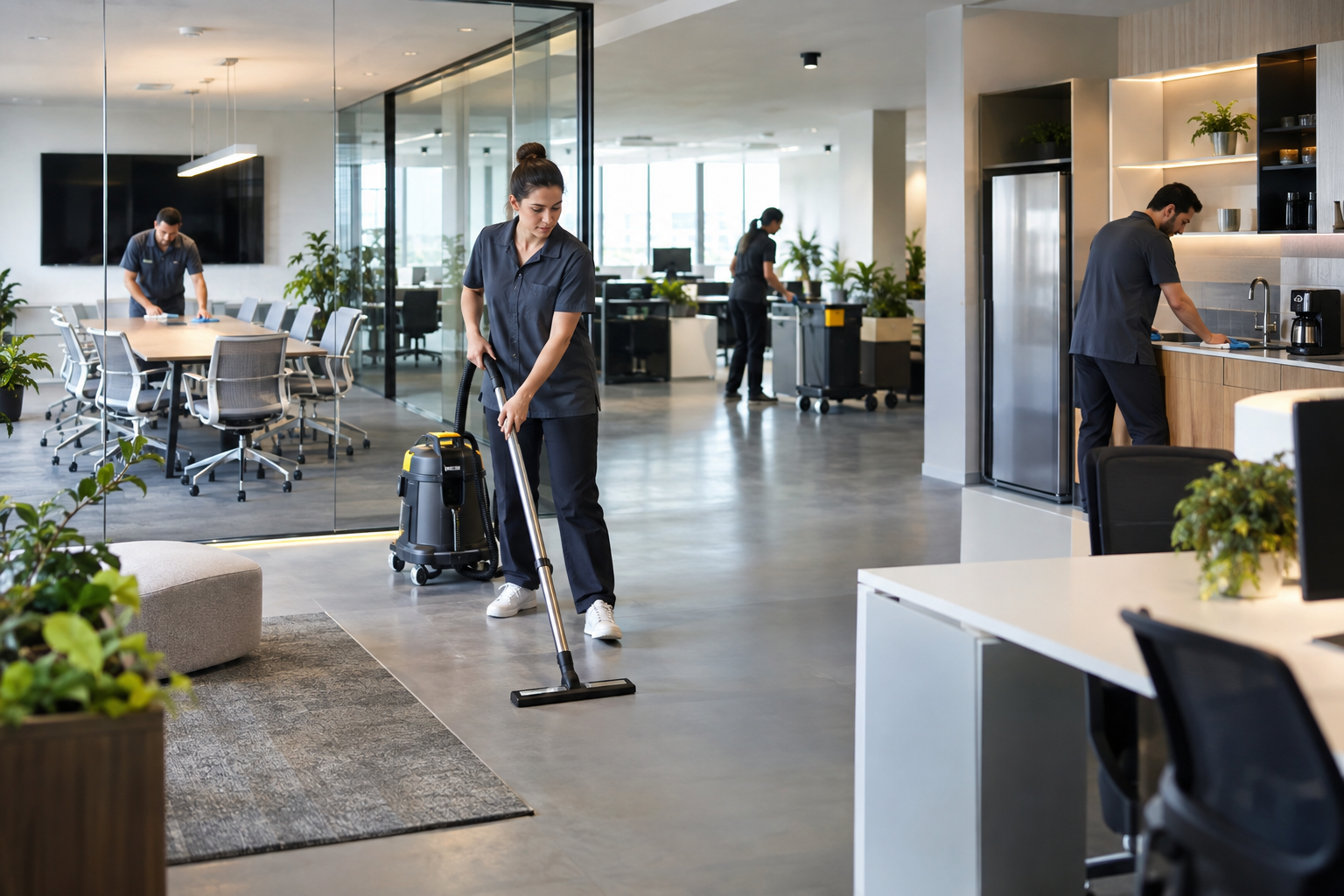

How can you organize office cleaning effectively?
Table of Contents
Ask ten office managers, «How many cleaning sessions per week do you have for your 400 m²?» You’ll get ten different answers, and most of them will have been estimated off the top of their heads or inherited from the previous service provider. The square meter remains the go-to metric for organizing office cleaning. It’s convenient and fits neatly on a quote line. Yet it tells us almost nothing about what actually gets dirty in your office.
Key Takeaways
-
Go beyond a simple calculation per square meter to organize a cleaning schedule based on actual foot traffic and the types of spaces (kitchen, meeting rooms)
-
KHOMCLEAN demonstrates that effective organization relies on analyzing human activity rather than just gross surface area to ensure hygiene and well-being
-
The Essential Steps for Developing Your Cleaning Protocol
-
Compare the options and take action.
A 15-square-meter shared kitchen used by 60 people every lunchtime generates more work than an 80-square-meter open-plan office that has been only half-occupied since the shift to remote work. Door handles, keyboards in flexible-office setups, and meeting rooms that are constantly booked—these are the areas that make the difference between premises that are actually clean and those that merely «look» clean. At KHOMCLEAN, we start with human activity, not just the total floor area.
In this article, we outline a practical method: the steps involved in a robust office cleaning protocol, why two desks that appear identical on paper require two distinct cleaning approaches, and how to develop a cleaning plan that is truly tailored to your specific needs.
The Essential Steps for Developing Your Cleaning Protocol
A sustainable cleaning protocol starts with an inventory, not a schedule. Before discussing frequency, list every type of space: workstations, meeting rooms, the kitchen or break room, restrooms, the reception area, hallways, and utility rooms. For each one, note what actually happens there: who uses it, how many times a day, and with what equipment. This inventory becomes the backbone of your cleaning specifications. Without it, you’re buying hours of labor, not results.
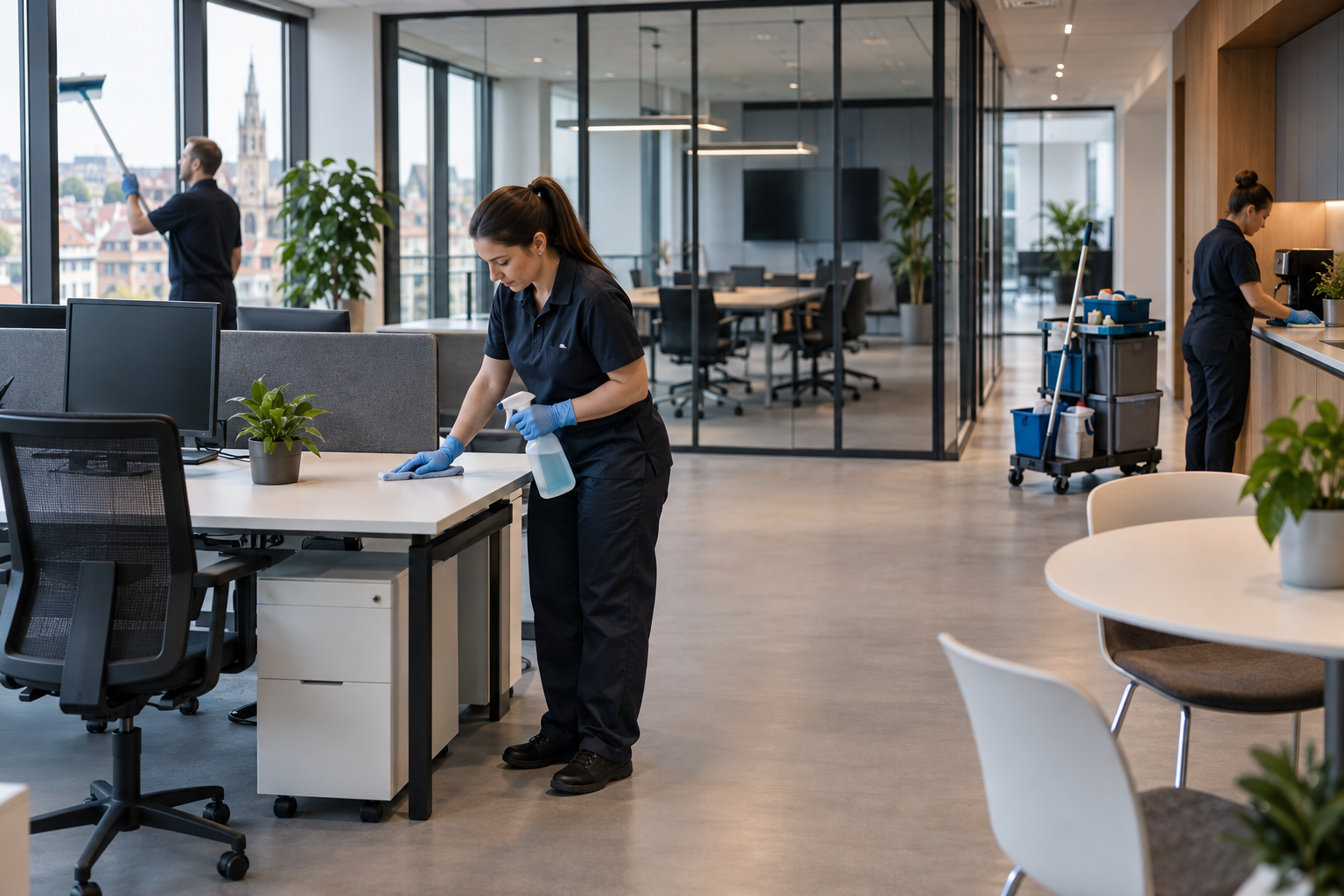
Next comes the question of order. What’s the best order for cleaning an office? The rule is always the same: from the cleanest to the dirtiest, and from top to bottom. We clean workstations and high surfaces before the floors, and we always finish with the restrooms. Cleaning these areas in the wrong order means spreading germs from one place to another, even with the best of intentions. Color-coding the cleaning cloths (blue for offices, red for restrooms, for example) ensures this approach is followed on the job, even when the cleaning staff member changes.
The four cleaning steps that must be followed for every surface are well known to professionals but are often overlooked elsewhere: dusting or removing debris, washing with detergent, rinsing when the product requires it, and then disinfecting high-touch surfaces. Disinfecting a surface that is still greasy is pointless. This is the core of a proper sanitation protocol, and it is where most sloppy cleaning efforts fall short.
There are three basic rules to follow. First, use the right product for the right surface: if you use a degreaser on a screen or an oiled wooden table, you’ll damage the surface. Cleaning sensitive surfaces (screens, designer furniture, wood floors, leather) requires specific instructions, clearly outlined in the cleaning protocol. Two, contact time: a disinfectant needs to remain in place—often for several minutes—to be effective. Third, traceability: a signed inspection sheet for each area; otherwise, you’ll never know what was or wasn’t done on a Tuesday in November.
The final step—and the one most often overlooked—is to formalize a cleaning action plan that specifies cleaning frequencies by area and checkpoints. Daily cleaning for restrooms, the kitchen, trash cans, and high-touch surfaces. Weekly for interior windows, dusting high surfaces, and baseboards. Monthly or quarterly for machine-cleaned floors, carpet cleaning, and light fixtures. This document is a work in progress; it’s not set in stone. A monthly review with your cleaning service provider allows you to adjust the plan without having to start from scratch.
Why Two Offices of the Same Size Require Different Layouts
Let’s take two 500-square-meter floors in the same building on the same level. The first houses an accounting firm: 25 people, assigned workstations, lunch eaten off-site, few visitors. The second houses a digital agency: 45 employees in a flexible office setup, a kitchen where people actually cook, and clients met with in a conference room three times a day. Same floor space, same cost per square meter if you look at it the wrong way. Two realities that are worlds apart.
The number of people using the premises is the first factor to consider. A workstation shared by three people throughout the day accumulates three times as many contacts as a dedicated office, and it must be disinfected between users, not just at the end of the day. A reception area that sees 40 visitors a day leaves smudges on the windows, marks on the floors, and a reception desk that needs to be cleaned up during the day. Conversely, an archive room open once a week does not require daily cleaning. Sending a staff member there every evening amounts to billed time spent on nothing—time that will be lacking elsewhere.
The type of space is just as important. The office kitchen is the number one critical area when it comes to hygiene in the workplace: microwaves, refrigerator handles, sinks, and coffee machines are hotspots for bacteria and odors. It requires special attention—often twice a day in facilities where employees eat lunch on-site—with a complete cleaning of the refrigerator scheduled weekly. Meeting rooms, on the other hand, get dirty in spurts: nothing for two days, then a seminar with 20 people and leftover meal trays. A rigid cleaning schedule doesn’t fit this pattern. You need a light daily routine and a deep clean triggered after heavy use, in line with your reservation calendar.
Remote work has changed the game. An office that is 40 % occupied on Mondays and Fridays and 90 % occupied on Tuesdays and Thursdays has no reason to be cleaned in exactly the same way five nights out of five. Observing actual office usage over three or four weeks is enough to reveal these patterns. We then focus our efforts on the busy days, scale back on the quiet days, and redeploy the time saved to areas that need it. That’s what cleaning optimization is all about: not doing less, but doing just the right amount, in the right place, and at the right time.
One final point that per-square-meter rate charts completely overlook: materials. A resin floor requires just one pass with a scrubber-dryer, while a carpet of the same size requires a brush vacuum cleaner and periodic injection-extraction cleaning. Glass everywhere means smudges everywhere. Before setting a number of hours, you need to walk through the premises with someone who knows what to look for.
Where to Get a Custom Maintenance Plan for Your Business Premises
One figure that comes up often in our discussions with general services managers: nearly one-third of complaints about a cleaning contract do not concern the quality of the work itself, but rather areas that were overlooked or subcontracted because they simply weren’t included in the initial scope of work. The problem almost always stems from the same source: a quote based on floor plans, without a site visit or discussion of how the space is used. You can’t tailor a maintenance plan using just a spreadsheet.
The KHOMCLEAN method begins with a site assessment. We walk through your facilities with you to identify high-traffic areas, sensitive zones, and surfaces that require specific cleaning products. We review your schedule to determine whether cleaning should take place early in the morning, in the evening, or during the day for restrooms and kitchens at high-traffic locations. We’ll ask you questions that may seem surprising at first (How many people eat lunch on-site on Tuesdays? Are your meeting rooms open to clients?), because it’s precisely these answers that determine the right level of service.
This visit results in a detailed cleaning specification, broken down by area, including cleaning frequencies, products used, checkpoints, and monitoring procedures. It is this document that forms the basis of the office cleaning quote—not the other way around. You’ll know exactly what’s being done, when, and how to verify it. You’ll have a single point of contact who’s easy to reach, knows your site, and can adjust the cleaning plan as your business evolves—whether that means the arrival of a new team, the redesign of an office space, or a change in remote work policies.
A reliable B2B cleaning service must also be able to handle unexpected situations without making them your problem. Replacing an absent staff member, providing one-time service after construction work, or preparing the space before a client event: these situations are part of everyday business, and they shouldn’t keep your office manager on the phone for two hours. KHOMCLEAN’s expertise is evident not only in the consistency of its results but also in its ability to handle these additional tasks.
If you’re reviewing your current setup, here’s a simple tip before issuing any request for proposals: review your current contract and look for references to your kitchen, meeting rooms, and points of contact. If they aren’t explicitly listed—along with a specified frequency—you’ve identified your first area for improvement. A request for a quote from KHOMCLEAN always begins with this assessment, and it often reveals discrepancies that no one had previously documented.
Conclusion
Organizing office cleaning effectively comes down to one idea: observing how your space is used before counting its square meters. An inventory of the spaces, a sanitation protocol that follows the proper sequence and the four steps of cleaning, and cleaning frequencies tailored to actual foot traffic and the nature of each area. The rest comes down to follow-through and attention to detail in execution.
Would you like a maintenance plan tailored to your specific needs rather than a standard one? Contact KHOMCLEAN to schedule a technical inspection of your facilities. We’ll come by, assess your needs, and propose a clear plan. You can focus on your business.
Frequently Asked Questions
Why isn't calculating by square meter enough to plan office cleaning?
Because floor space says almost nothing about what actually gets dirty. A 15-square-meter shared kitchen used by 60 people every lunchtime generates more work than an 80-square-meter open-plan office that’s been half-empty since people started working from home. It’s foot traffic, the type of spaces, and the materials that determine the workload—not the gross square meters.
In what order should you clean an office to avoid spreading germs?
The rule is always the same: from cleanest to dirtiest, and from top to bottom. Start with workstations and high surfaces, then move on to the floors, and always finish with the restrooms. A color-coding system for cleaning cloths—blue for offices and red for restrooms, for example—helps ensure this approach is followed consistently on the job, even when the cleaning staff member changes.
How often should different areas of an office be cleaned?
Daily cleaning includes restrooms, the kitchen, trash cans, and high-touch surfaces. Weekly cleaning covers interior windows, dusting high surfaces, and baseboards, while machine-cleaned floors, injected carpets, and light fixtures are cleaned monthly or quarterly. These cleaning frequencies are not set in stone: a monthly review with the service provider allows for adjustments.
Why do corporate kitchens require special treatment?
This is the number one critical issue when it comes to hygiene in the workplace: microwaves, refrigerator handles, sinks, and coffee machines are hotspots for bacteria and odors. In workplaces where people eat lunch on site, this area often requires cleaning twice a day, supplemented by a complete cleaning of the refrigerator scheduled once a week.
How can you adapt office cleaning to accommodate remote work and slow days?
All it takes is observing the actual use of the space over three or four weeks to identify occupancy patterns. A space that is 90% full on Tuesdays and Thursdays but only 40% full on Mondays and Fridays has no reason to be cleaned in exactly the same way five nights out of five. We therefore focus our efforts on the busy days and redirect the time saved to areas that need it.
What should you check in your cleaning contract before issuing a request for proposals?
Review the current contract and look for explicit mention of the kitchen, meeting rooms, and contact points, along with their associated frequency. Nearly one-third of customer complaints stem from areas that were overlooked because they were excluded from the initial scope—often due to a quote based on blueprints without an on-site visit. In fact, KHOMCLEAN begins every quote request with this on-site assessment.


 Français de Belgique
 English
 Nederlands (België)
0 Comments