

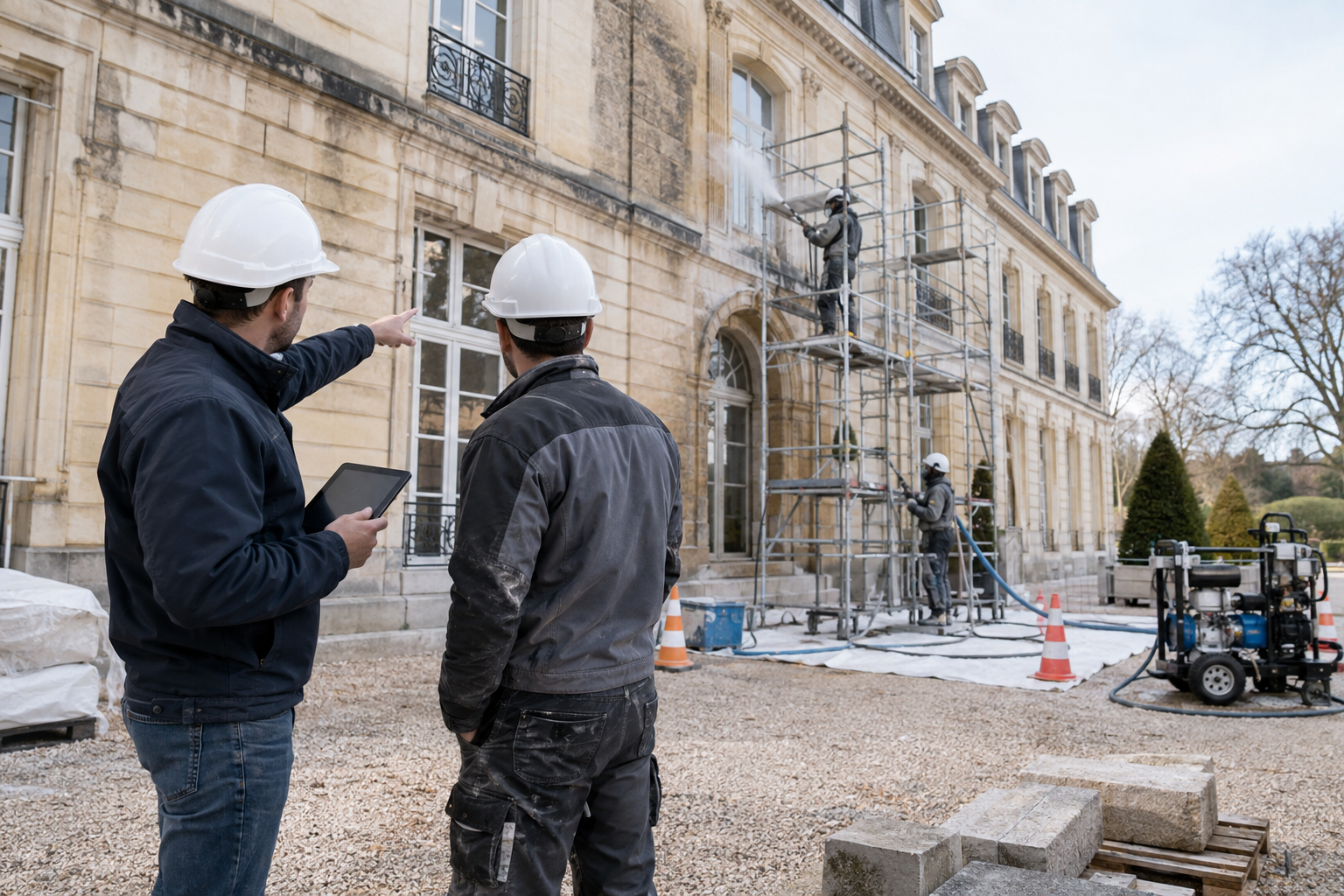

Professional Facade Cleaning: Expertise in Assessment
Table of Contents
-
Surface Assessment: Criteria for Selecting the Appropriate Protocol
-
Comparison of Techniques: Hydro-Scrubbing vs. High-Pressure Cleaning
-
Safety and Precautions: Organizing a Professional Construction Site
A blackened facade doesn’t necessarily require aggressive cleaning. On soft stone, an improperly adjusted water jet can remove the dirt—and part of the material along with it. The result may look clean at first glance, but the weakened surface becomes more susceptible to water and further soiling. This is subtle damage that can sometimes be irreversible.
Key Takeaways
-
KHOMCLEAN positions itself as a consulting expert rather than merely an implementer
-
The approach is based on the primacy of technical assessment: understanding the interaction between the material and its environment to prevent irreversible damage, while ensuring the safety of the B2B construction site ecosystem
-
Criteria for Selecting the Appropriate Protocol
-
Hydro-blasting vs. High-Pressure Cleaning
For KHOMCLEAN, professional facade cleaning therefore begins with a technical decision: understanding what is being cleaned before deciding on the best approach. Materials, deposits, the condition of the joints, exposure, and operational constraints must guide the cleaning protocol. For a property manager, this approach serves a concrete goal: restoring a clean facade without compromising its preservation or unnecessarily disrupting the building’s operations.
Surface Assessment: Criteria for Selecting the Appropriate Protocol
What is really behind that dark streak under a window? Atmospheric deposits, particle-laden runoff, or biological growth caused by a leak? The color alone isn't enough to tell. The surface diagnosis must relate the nature of the soiling to the material and the conditions under which it formed.
The first assessment focuses on the substrate: limestone, brick, concrete, mineral-based plaster, organic coating, or metal siding. These categories provide guidance, not authorization for cleaning. Two types of limestone can have very different levels of resistance. Similarly, sound concrete and cracked concrete with exposed rebar do not follow the same cleaning protocol.
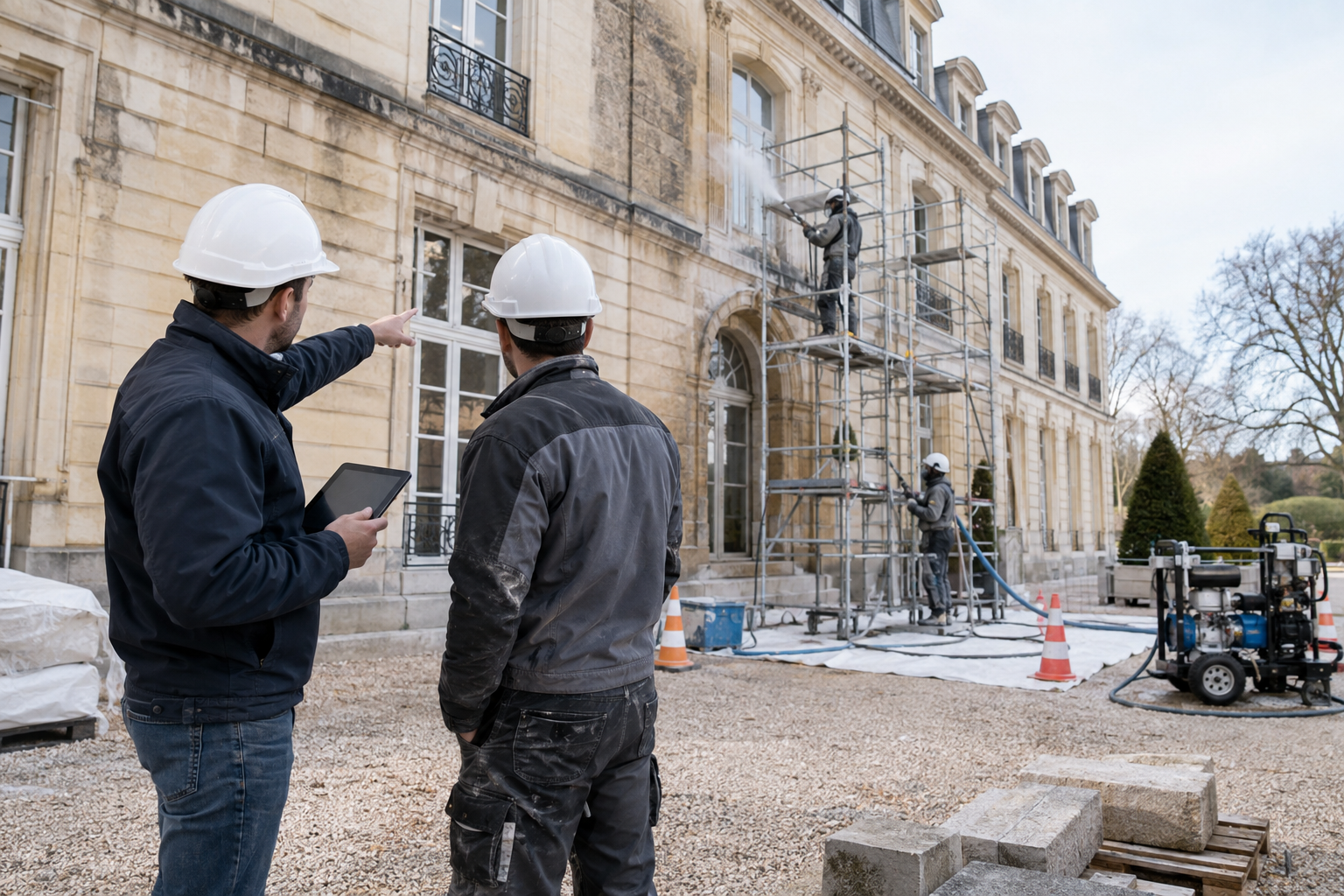
The substrate porosity is just as important as its hardness. An absorbent material can retain water and chemicals, posing risks of salt migration, staining, or damage when frozen. The condition of the joints, cracks, peeling, and previous repairs must be identified before any water is applied. On exterior thermal insulation, the finish coat requires special attention and strict adherence to the system’s specifications.
Identifying these patterns then makes it possible to distinguish between helpful approaches and bad habits:
-
Dust and lightly adhering deposits: Start with a less aggressive method, then evaluate the results.
-
Algae and other biological growths: Check for persistent moisture and, if treatment is necessary, verify that it is suitable for the substrate and review its conditions of use.
-
Efflorescence: Identify the salts and the source of the water transfers before returning them to solution through washing.
-
Traces of rust, graffiti, or black crusts: Plan targeted tests, as a single facade may require several localized interventions.
The assessment must also identify any chemical incompatibilities. An acidic product can corrode limestone; an unsuitable detergent can damage a metal finish. Depending on the planned work, a suspicious old coating requires the appropriate regulatory assessments to be conducted before any action is taken that could release hazardous dust.
The next logical step is a representative test area, examined after drying. This step confirms the result, as well as the absence of erosion, changes in texture, or discoloration. The selected settings are recorded. If the substrate is already disintegrating, cleaning is no longer the priority: a repair or technical restoration must be considered before proceeding.
Comparison of Techniques: Hydro-Scrubbing vs. High-Pressure Cleaning
Two water-based processes can have very different effects on a building facade. Hydro-blasting typically combines air, water, and a fine abrasive, all sprayed under controlled conditions. High-pressure cleaning relies primarily on the mechanical action of the jet. It would be misleading to compare them solely on the basis of power: it is the characteristics of the surface and the deposit that determine which facade cleaning method is best suited.
Hydro-blasting is suitable for certain adherent deposits on sufficiently cohesive mineral substrates. It allows for gradual work, particularly on certain types of stone, brick, or concrete surfaces. However, the word «gentle» is no guarantee. The type and particle size of the abrasive, its flow rate, the pressure, the distance, and the duration of contact determine the amount of wear caused. An improper setting can dull a texture or remove the surface layer of the material.
This technique also requires specific precautions: protecting adjacent surfaces, containing splatter, and collecting wet residue. It is not the default choice for crumbly plaster, fragile decorative elements, or thin coatings.
High-pressure processing remains an option for certain substrates that are durable, sound, and compatible with the process. Its effectiveness against surface deposits should not obscure its mechanical risks: deepening of joints, peeling of the finish, exposure of aggregates, or water penetration behind the facing. Moreover, the pressure displayed on the machine does not, by itself, indicate the actual aggressiveness of the cleaning process. The nozzle, flow rate, angle, and working distance significantly affect the impact.
For a painted facade or a delicate stucco surface, the low-pressure cleaning, possibly in combination with a compatible product and careful manual application, is often worth trying first. It reduces certain stresses without eliminating the risks of seepage or chemical incompatibility.
Fogging operates on a different principle: gradually moistening certain deposits to help loosen them. It may be suitable for certain mineral facades, selected after testing, but requires time and careful monitoring of water application. A substrate with high salt content or with paths of water infiltration may make this solution unsuitable.
To compare a service provider’s proposals, consider three criteria:
-
Does the process remove the deposit without altering the texture or the expected finish?
-
Do the tests demonstrate that it is compatible with all relevant areas, including repairs?
-
Are water consumption, discharges, and effluents under control at this specific site?
Eco-friendly cleaning, therefore, is not simply about avoiding detergents. The amount of abrasive used, the water consumed, the waste generated, and the preservation of materials are also factors to consider. The correct method is the least aggressive of those that achieve the validated result.
Safety and Precautions: Organizing a Professional Construction Site
At the entrance to an occupied building, a single splash is enough to turn a cleaning operation into an operational incident. Site preparation is not a mere logistical detail: it determines the safety of the cleaning staff, the occupants, and business continuity. It must be defined in advance of equipment installation, in consultation with the site manager.
Three rules guide the project: ensure the safety of people, protect the building, and control emissions. This involves clear on-site signage, maintaining pathways away from exposed areas, and ensuring that emergency exits remain accessible. Schedules are adjusted to accommodate deliveries, public access, and the operational constraints of the businesses on-site. If the construction site encroaches on public property, the necessary permits must be obtained in advance.
The method of access is chosen based on the height, the geometry of the facade, the load-bearing capacity of the ground, and the installation options. Scaffolding, aerial work platforms, and rope access are not interchangeable. Collective protective measures take priority; the use of ropes requires justification appropriate to the work conditions and a rescue plan. Training, equipment inspections, and contractor coordination are part of the safety measures, along with a risk prevention plan when required.
Surface protection applies in particular to glass, window and door seals, sensitive metals, light fixtures, and electrical equipment. Air inlets require coordination with the facility operator: they must not be blocked without first verifying the impact on ventilation. Surrounding plants and soil must also be protected from chemicals and splashes.
The written protocol specifies the sequence of operations, the approved settings, any required dosages and contact times, and the procedures for rinsing and inspection. Temperature, wind, and the risk of frost may necessitate postponing the treatment. A product that dries too quickly in the sun does not work as intended; wind-blown spray can drift outside the protected area.
Should the principles of bio-cleaning be applied? Not in the same way as in an operating room: a building facade does not require the same level of disinfection as a hospital. The four factors of Sinner’s circle—mechanical action, chemical action, temperature, and time—help explain the effectiveness of cleaning, but they do not constitute four universal rules of bio-cleaning. Here, the primary goal is to achieve a level of cleanliness that is compatible with the preservation of the surface.
Finally, wash water may contain paint particles, abrasives, or substances resulting from treatment processes. Plans must be made to collect this water and direct it to an appropriate disposal system, based on its composition and local regulations. Discharge into the stormwater system is not an acceptable default disposal method. The final inspection also covers these points, not just the appearance of the facade.
Conclusion
The lightest-colored facade isn’t always the cleanest. Excessive stripping may give the impression of immediate results while erasing a patina, accentuating differences between repairs, or weakening the surface. The true measure of success is the removal of deposits to the agreed-upon level, without damaging the material or causing disruption to the building.
To effectively manage the maintenance of a commercial building, the manager should therefore specify their needs in a way other than simply saying, «Clean the entire facade.» It is necessary to specify the areas involved, the desired result, occupancy constraints, and any known defects. This information allows the service provider to propose a tailored solution, rather than a one-size-fits-all approach applied to surfaces that vary in condition and durability.
Before giving your approval, ask for verifiable information: the findings of the assessment, the test results, the limits of the expected outcome, and the safety precautions. Some old staining may remain even after a properly conducted treatment. It’s better to point this out before the work begins than to apply multiple coats until the surface is damaged. The quality of advice is also measured by the ability to set such limits.
The final inspection requires the same level of detail. Photographs taken under comparable conditions, an inspection after drying, and a record of the products and processes used provide a useful basis for future work. Any reservations must distinguish between remaining soiling and variations inherent to the material. This report helps the property manager or technical manager track the building’s actual aging process.
The next step isn't necessarily to schedule frequent cleanings. Fixing a faulty drain, checking a seal, or stopping an abnormal leak can slow down the reappearance of stains. The frequency of maintenance should be determined based on exposure and observations, not on a one-size-fits-all schedule for all buildings.
Are you planning a professional building facade cleaning project? Contact KHOMCLEAN to assess your site’s specific needs and constraints. Available plans, photographs, a history of the work, and information on the building’s current use will help facilitate a productive technical discussion focused on the sustainability of the final result.
Frequently Asked Questions
Why is an assessment necessary before cleaning a blackened facade?
A dark stain may result from atmospheric deposits, runoff, or biological growth: its appearance alone is not sufficient to determine the appropriate treatment. The diagnosis links the soiling to the material, its porosity, the condition of the joints, and the exposure conditions. For KHOMCLEAN, this step allows us to define an appropriate protocol and then validate it on a test area that is examined after drying.
How do you choose between hydro-blasting and high-pressure cleaning?
Hydro-blasting typically combines air, water, and a fine abrasive; it may be suitable for certain adherent deposits on sufficiently cohesive mineral substrates. High-pressure blasting relies primarily on the mechanical action of the jet and is reserved for resistant, sound, and compatible substrates. The choice depends on test results: the right process removes the deposit without altering the texture or finish, while keeping spray and effluent under control.
In what situations is it best to postpone or avoid cleaning a building facade?
If the substrate is already deteriorating, repairs or technical restoration must be considered before proceeding with cleaning. Cracks, deteriorated joints, or areas where the surface is peeling away must be identified before any water is applied, while a suspicious old coating may require regulatory inspections depending on the planned work. Temperature, wind, or the risk of freezing may also warrant postponing the work.
What information should you ask the service provider for before confirming the service?
Request the diagnostic findings, test results, limits of the expected outcome, and site safety measures. The written protocol must specify the procedures, validated settings, any required dosages and contact times, as well as rinsing and inspections. Some old staining may remain despite a properly performed treatment: this limitation should be disclosed rather than attempted to be masked by additional passes that could damage the substrate.
How do you organize the cleaning of a building's exterior while the building is occupied?
The plan must be developed in consultation with the facility manager to ensure the safety of people while maintaining business continuity. It should include signage, designated routes away from exposed areas, accessible emergency exits, and schedules adapted to accommodate deliveries or public access. It is also necessary to protect equipment and adjacent surfaces, coordinate any protection of air intakes with the facility operator, and make provisions for the collection of wash water.
How can you minimize the reappearance of marks after cleaning a building facade?
The next step isn’t necessarily to increase the frequency of cleaning: fixing a faulty drain, monitoring a seal, or eliminating abnormal runoff can slow the reappearance of stains. The frequency of maintenance depends on exposure and observations, not on a one-size-fits-all schedule for all buildings. Comparable photographs and a record of the products and processes used help track the actual aging of the facade.

 Français de Belgique
 English
 Nederlands (België)
0 Comments