


How do you organize a post-construction cleanup?
Table of Contents
-
Distinguishing Between Routine Maintenance and Technical Repairs
-
Coordination and Prerequisites: Successfully Completing the Final Delivery
A building can be completed without being ready for occupancy. Plaster dust in the window and door tracks, a film on the tile floors, glue marks on the windows: these details alone are enough to detract from the overall impression of the work done. And some residues, if not properly cleaned up, can permanently damage new materials.
Key Takeaways
-
KHOMCLEAN offers an engineering-based approach to cleaning: distinguishing between technical restoration and routine maintenance by addressing fine dust and debris in a strict chronological order to ensure a defect-free project handover.
-
Distinguishing Between Routine Maintenance and Technical Repairs
-
Strategic Scheduling
-
Ensuring a Successful Final Delivery
Professional Post-Construction Cleaning: How to Organize a Cleanup? The solution starts with planning, not with choosing a cleaning agent. The KHOMCLEAN approach is based on a cleaning engineering methodology: identifying surfaces, classifying types of dirt, scheduling cleaning tasks, and verifying the results before delivery. The goal of zero defects requires a method, clear responsibilities, and shared acceptance criteria.
Distinguishing Between Routine Maintenance and Technical Repairs
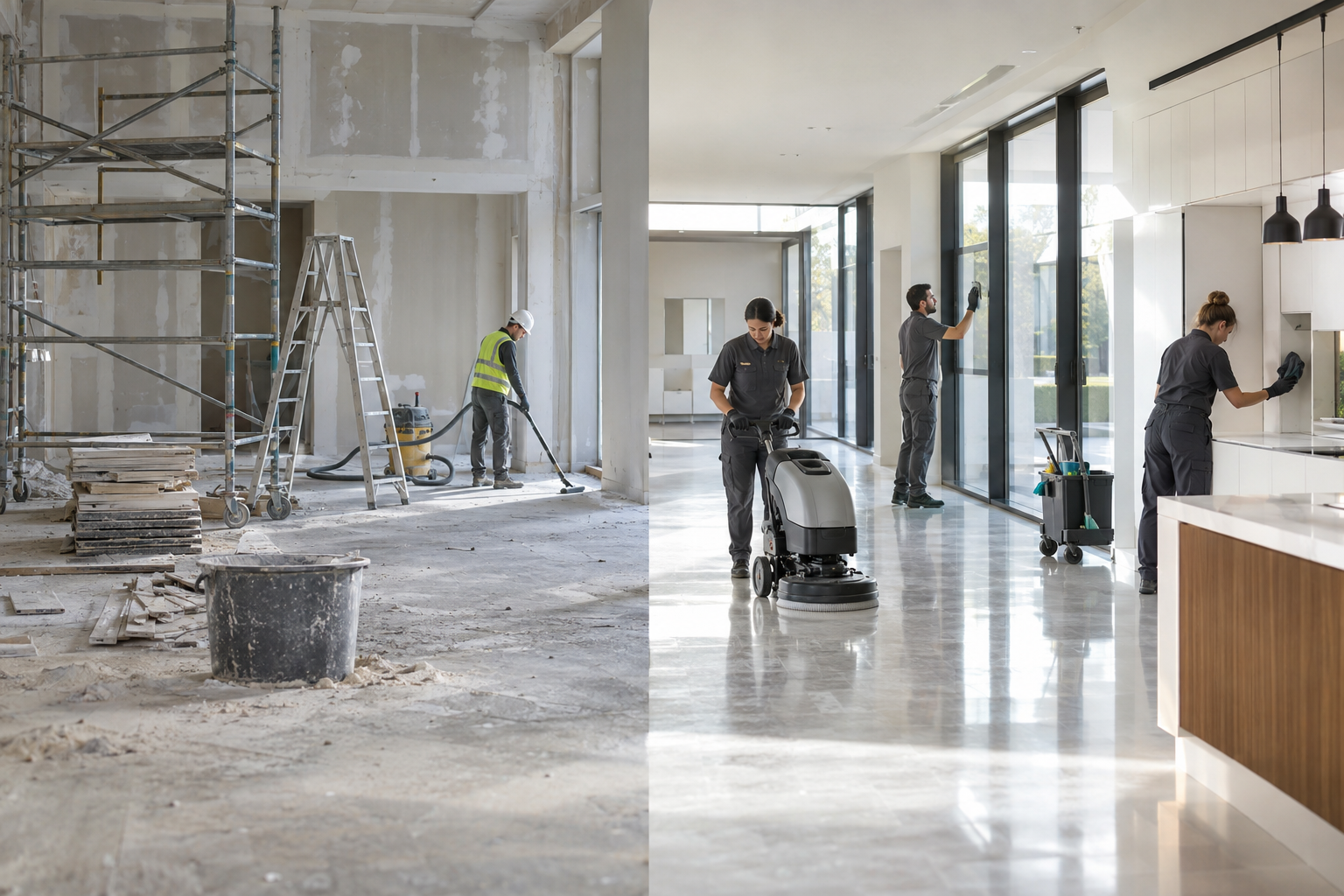
Is running a floor scrubber through new facilities enough to make them spotless? No, especially if fine dust and stubborn deposits haven’t been addressed beforehand. Routine maintenance removes dirt caused by the use of the space. Technical restoration tackles the aftermath of construction work: splatters, cement slurry, adhesives, protective films, and dust lodged in hard-to-reach corners.
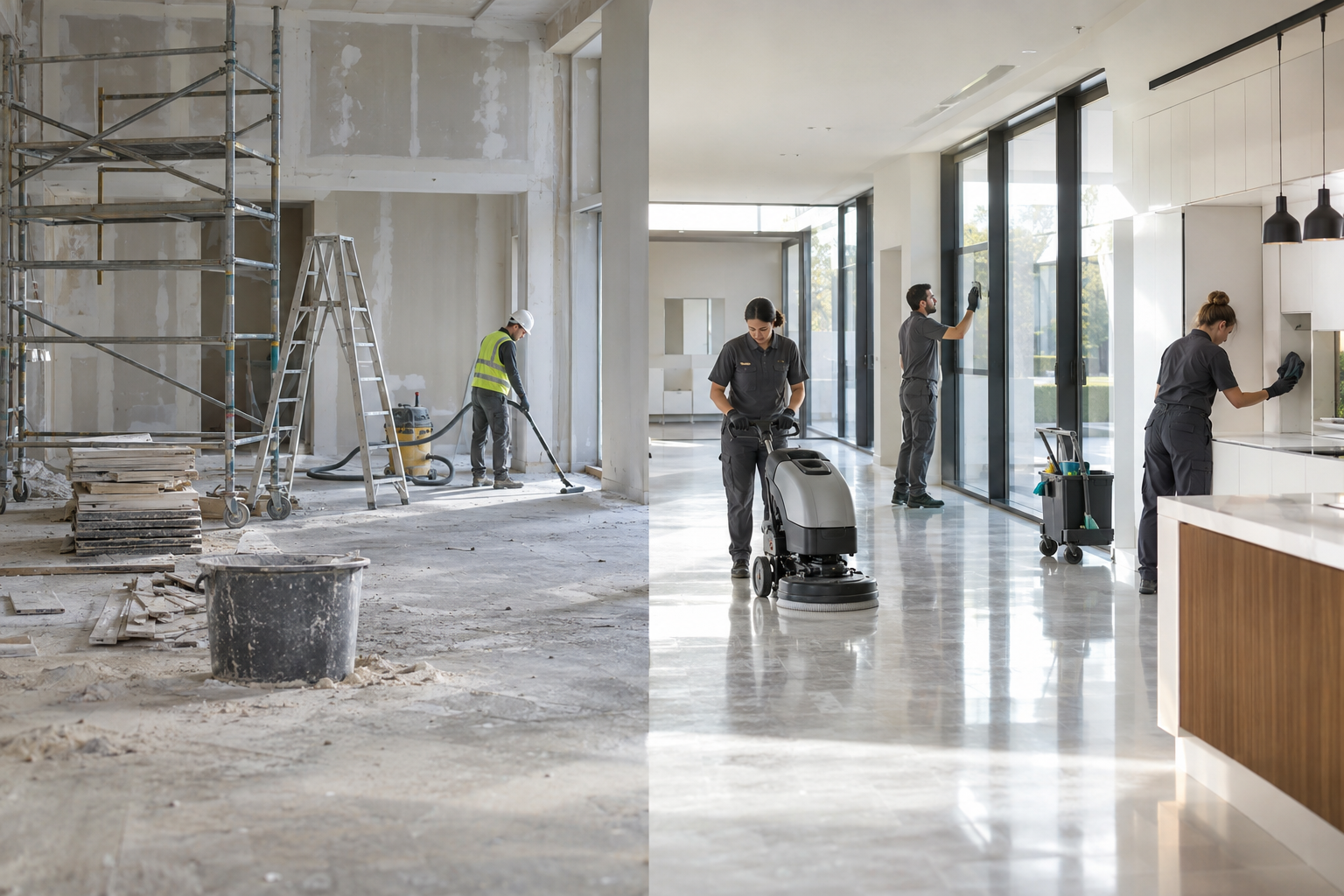
This difference changes everything: the materials, the products, the time required, and the skills involved. “Refurbishment,” as used here, refers to the desired visual result, not to the repair of the structures. Cleaning will not fix scratches, installation defects, or missing finish. These anomalies must be identified and reported, ideally with photographs taken before any work is performed.
The initial assessment takes two factors into account: the nature of the surface and that of the deposit. A cement film on porcelain tile is not treated the same way as a splatter on marble. An acidic product can damage limestone; a solvent can damage paint or a plastic coating. The same caution applies to treated glass surfaces, for which the manufacturer may advise against scraping.
-
Formats: Identify the materials, their finishes, and the available care instructions.
-
Construction debris: distinguish between loose dust, caked-on deposits, and greasy or sticky residue.
-
Initial state: document existing defects and components that are still fragile.
-
Compatibility: Test the protocol on a small, inconspicuous area before applying it more widely.
Plaster dust, in particular, requires effective extraction before washing. If wetted too soon, it forms a slurry that spreads into the joints and leaves a hazy film as it dries. Dry sweeping and air blowers should be avoided: they resuspend the particles instead of removing them. Vacuuming must be done using equipment with a filtration class appropriate for the identified dust.
One distinction must be clear: a standard post-construction cleanup is not a decontamination operation. If there is any doubt regarding asbestos, lead, or other hazardous substances, work in the affected area must be suspended, and the risk must be assessed. No deadline justifies proceeding without proper assessment.
The KHOMCLEAN Methodology: Strategic Scheduling
Three rules guide the work: proceed from top to bottom, from the least dirty to the dirtiest, and from the back of the premises toward the exit. These are operational guidelines, not a universal standard. When the project is nearing completion, they are part of a order of operations precise, tailored to the materials and traffic conditions.
The KHOMCLEAN method emphasizes zone-based cleaning. Each area follows a complete cleaning sequence, after which access is restricted to prevent new dirt from accumulating. Cleaning an entire floor without monitoring contractor traffic often results in having to clean the same area twice. It’s better to proceed by sectors that are actually available, with a status known to everyone: to be cleaned, in progress, completed, or to be re-cleaned.
-
Clear the surfaces. Organize the removal of debris, the sorting of waste, and the disposal of packaging within the agreed-upon scope. Remove protective coverings only when the structures are no longer at risk of being damaged by the remaining work.
-
Remove the dust. Vacuum hard-to-reach areas, ledges, outdoor equipment, woodwork, and floors. Ventilation systems and the interiors of technical equipment fall under a specific scope to be defined.
-
Dispose of the residues. Treat traces of glue, paint, or cement locally using a method approved for each surface. Follow the dilution instructions, contact time, and safety guidelines.
-
Clean surfaces and equipment. Clean windows, window frames, doors, closets, and bathroom fixtures using clean, separate tools. Cleaning should not spread dirt from one area to another.
-
Finish with the floors. Choose between the manual or mechanized process depending on the coating. Rinse as specified in the protocol, collect the wastewater, and allow to dry before inspection.
Let’s take an office where the partitions have just been sanded. Washing the floor immediately might make it look clean for a few minutes. However, the residue left on door tops and exposed cable trays will eventually make it dirty again. Pre-vacuuming prevents this from happening and reduces the spread of particles.
The interim inspection concludes each sequence: no visible residue, targeted marks removed, and the surface intact. If a stain persists, its nature is reassessed before increasing the intensity of the treatment. Simply rubbing with an abrasive is not the right approach.
Finally, the recommended drying and curing times for paints, sealants, or coatings must be followed. A tight schedule does not make a freshly applied material more durable.
Coordination and Prerequisites: Successfully Completing the Final Delivery
A painter returns to touch up a room that has already been cleaned. He sands a few centimeters, walks down the hallway, and leaves footprints all the way to the elevator. This common scenario explains why coordination is just as important as execution. The restoration work must be scheduled during a dedicated time slot, with any remaining tasks identified in advance rather than discovered on-site.
Before confirming this time slot, the project owner, the project manager, and the service provider must jointly verify the prerequisites. Access to the construction site involves more than just handing over a set of keys. It includes safe access routes, handling requirements, access authorizations, and the ability to reach every area specified in the contract.
-
Make sure you have water, electricity, and lighting that allows you to see any defects.
-
Confirm that work generating dust has been halted in the affected areas.
-
Provide appropriate means of access to windows and surfaces at height.
-
Identify storage areas, disposal routes, and authorized management procedures for wash water.
-
Appoint a contact person who can approve a route or resolve a dispute.
With regard to obligations, there is no single cleaning service that applies to all contracts. The contractual documents—in particular the Technical Specifications and the clauses for each lot—specify who is responsible for waste removal, who performs the final cleaning, and what results are expected. In France, waste producers or holders must manage waste themselves or ensure it is managed in accordance with regulations. Entrusting its removal to a third party does not automatically relieve them of their responsibilities.
The budget issue is also determined by the scope of the project, not by an isolated average. In B2B cleaning, floor area alone is not sufficient to determine the scope of the job: the volume of debris, the height of the windows, sensitive materials, and additional access points and walkways all affect the workload. A site visit allows you to compare quotes that actually cover the same tasks, without confusing the initial cleaning with follow-up work after touch-ups.
The final inspection The inspection is conducted on dry surfaces, under adequate lighting, with one checklist per room: streak-free windows, clear tracks, dust-free floors, clean restrooms, and treated touchpoints. Any discrepancies are identified, photographed if necessary, and then assigned to the appropriate staff member.
This inspection accompanies the handover of the building and facilitates the resolution of outstanding issues. It does not replace the final acceptance of the work: a trace of adhesive is a matter for cleaning, while a scratched window pane requires an analysis of the defect and liability. Making this distinction prevents the contractor from being asked to «clean up» what actually needs to be repaired.
Conclusion
The most time-efficient decision is to prepare for the restoration before the project is declared complete. At this stage, it is still possible to reserve access points, consolidate touch-ups, and obtain material specifications. The day before delivery, these same issues become competing emergencies.
To move from the guide to the schedule, create a brief and actionable work plan. It should enable a team arriving on site to immediately understand what they need to address, under what conditions, and to what standard. There’s no need for a lengthy document: the right information, approved by the right people, is all that’s needed.
-
A map of the available areas: Indicate which spaces have been vacated, which areas are still occupied by businesses, and which access routes must be maintained.
-
An inventory of sensitive areas: Please include relevant references, manufacturer instructions, and any processing restrictions.
-
A breakdown of benefits: Please specify the disposition of debris, protective coverings, hard-to-reach windows, and technical equipment.
-
A validation schedule: Specify the inspection schedule and the procedure to follow when a clean area is to be reopened for work.
Add one point that’s often overlooked: Who takes over after the cleaning is done? If the premises remain unoccupied for several days, foot traffic, a furniture delivery, or exterior work may warrant a visual inspection before the occupants arrive. This inspection should be distinguished from the main cleaning operation, so that everyone knows what is planned.
The goal of zero defects must be managed; it cannot be simply decreed. It requires that surfaces be treated with care, dust be thoroughly removed, and any issues be documented until they are resolved. A flawless result at a given moment is not enough if there is no system in place to maintain it until the keys are handed over.
To arrange your professional post-construction cleanup, provide KHOMCLEAN with your floor plans, your projected schedule, and a list of remaining tasks. Request a site visit to determine the resources needed, the sequence of tasks, and the acceptance criteria. This will give you a clear foundation for preparing the handover, without leaving any last-minute details to chance.
Frequently Asked Questions
Why isn't a routine cleaning enough after construction work?
Routine cleaning removes dirt resulting from the use of the premises, while technical restoration addresses fine dust, splatters, adhesive residue, and cement deposits left behind by construction work. This process requires an assessment of the surfaces, appropriate equipment, and a precise procedure: simply running a scrubber-dryer over the floor will not remove dust accumulated in corners or stubborn deposits.
In what order should the premises be cleaned after construction work?
The KHOMCLEAN method involves clearing surfaces, vacuuming up dust, removing localized residue, cleaning surfaces and equipment, and then finishing with the floors. Work proceeds zone by zone, from top to bottom and from the back toward the exit, with controlled access to prevent re-soiling of completed areas. Wetting plaster dust too early creates a slurry that spreads into the joints.
When should you schedule the post-construction cleanup?
Preparations for the restoration begin before the end of the construction project, but the work window must be protected from any ongoing construction activities that generate dust in the affected areas. Before confirming the schedule, it is necessary to check access points, water, electricity, lighting, and any remaining touch-ups. The drying and curing times for materials remain a priority, even as the handover date approaches.
What factors should you compare when reviewing post-construction cleaning quotes?
Surface area alone is not sufficient for comparing quotes: the volume of debris, sensitive materials, the height of the windows, and additional access points and walkways all affect the workload. A site visit helps establish a common scope of work, particularly regarding debris, protective measures, and technical equipment. The quote must also distinguish between the main work and any follow-up work required after touch-ups or subsequent inspections.
How can you avoid damaging new materials while cleaning?
You must identify each surface and each coating, check the manufacturer’s instructions, and test the treatment on a small, inconspicuous area before applying it more widely. An acid can damage limestone, a solvent can damage paint, and scraping may not be recommended on certain types of treated glass. If a stain persists, its nature should be reassessed rather than immediately resorting to a more aggressive treatment.
How can you verify that the premises are ready for occupancy?
The final inspection is conducted on dry surfaces, under adequate lighting, and includes checking the windows, tracks, the absence of streaks on the floors, the restrooms, and contact points. Any issues are identified, photographed if necessary, and assigned to the appropriate person. This inspection does not replace the final acceptance of the work: a glue residue is a cleaning issue, but a scratch or installation defect requires a different course of action.


 Français de Belgique
 English
 Nederlands (België)
0 Comments