


Office Cleaning: Which Cleaning Service Should You Choose for Your Premises?
Table of Contents
-
The Three Organizational Models: Advantages and Logistical Challenges
-
Strategic Criteria for Making a Choice: From Security to Privacy
-
The Service Provider’s Adaptability: The Secret to a Smooth Cleaning Experience
A vacuum cleaner during a video conference, an alarm going off after the staff has left, a meeting room that’s still damp when a client arrives: even a job well done can be a nuisance if it happens at the wrong time. Choosing the right time slot is just as important as the quality of the work.
Key Takeaways
-
Compare the three niches using specific B2B criteria: security, noise, and privacy
-
KHOMCLEAN positions itself as a flexible partner that adapts its schedule to each client’s unique operations rather than imposing a standard model
-
logistical advantages and constraints
-
From security to privacy
Morning, afternoon, or evening? Properly organizing office cleaning depends less on your official hours than on the actual day-to-day operations of your premises. To make the right choice, you need to take a close look at three factors: access, noise, and privacy. At KHOMCLEAN, the principle is simple: we tailor our services to how your business operates, rather than asking you to adapt to a standard schedule.
The Three Organizational Models: Advantages and Logistical Challenges
Three time slots, but not three interchangeable options. To make a meaningful comparison, consider the earliest arrivals, the latest departures, and peak occupancy times. The opening hours posted at the front desk don’t always reflect what’s actually happening in the offices.
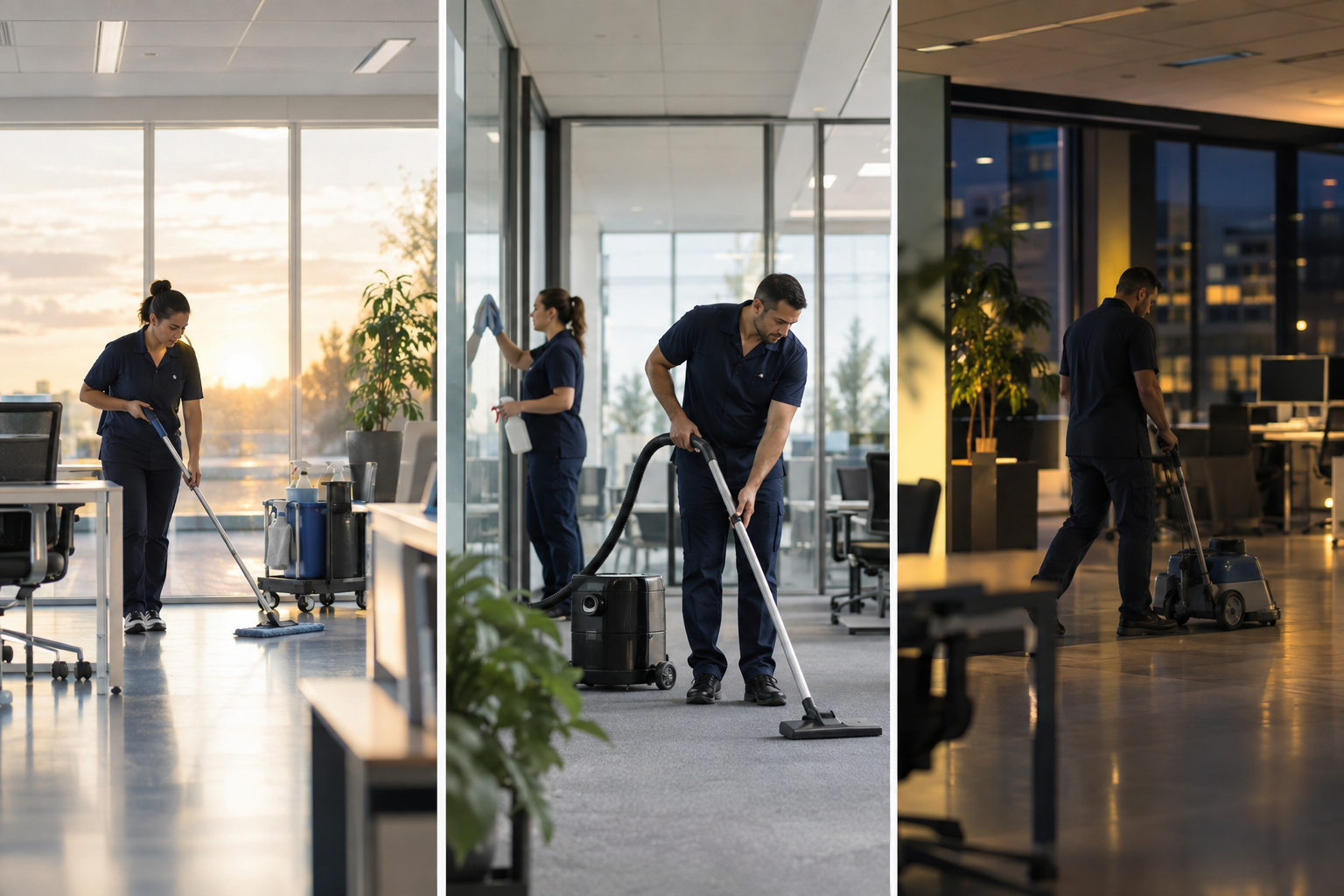
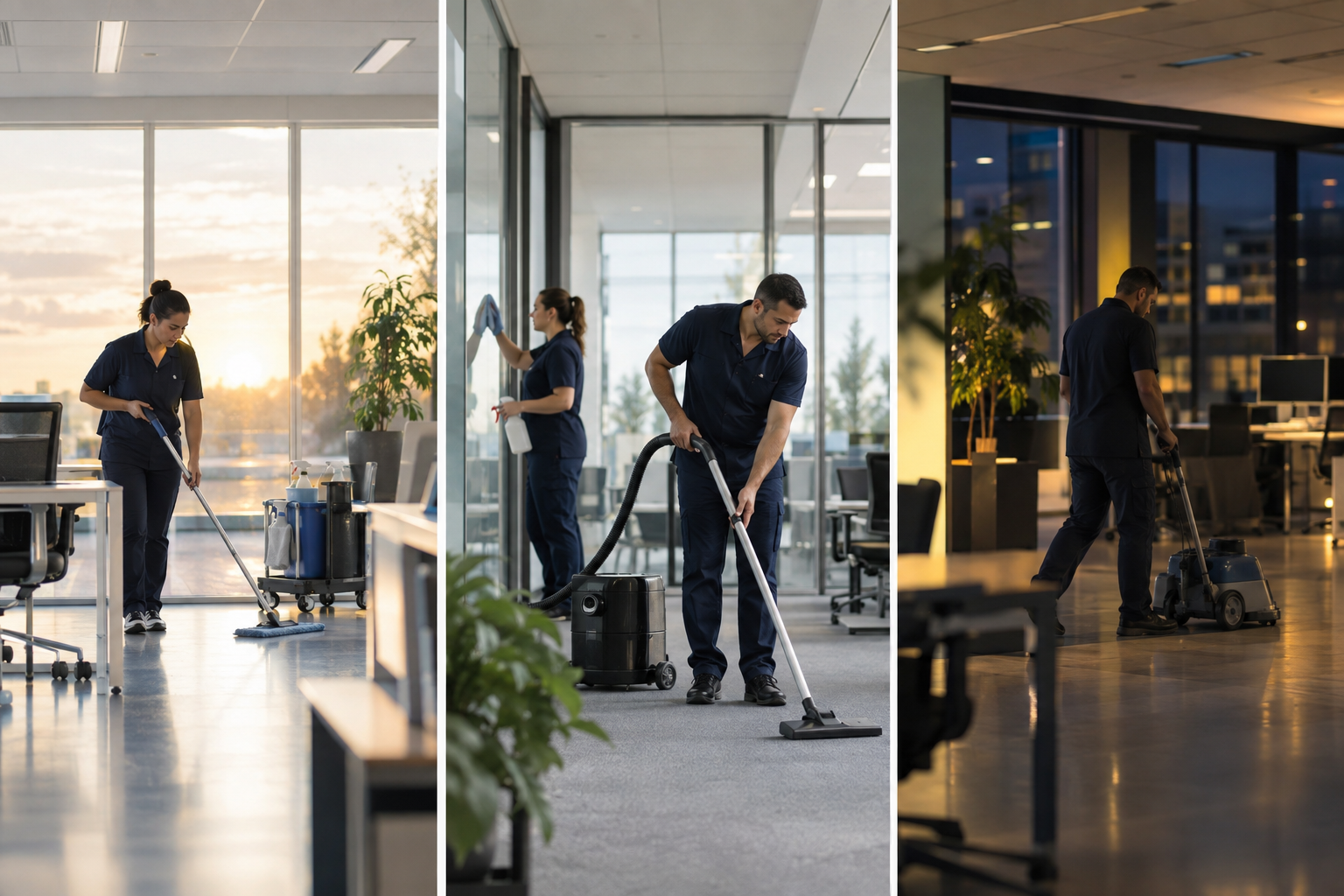
In the morning: the facilities are ready before the teams arrive. Cleaning the offices before opening is ideal for companies whose employees arrive at fairly regular times. The restrooms, kitchen, and reception areas are clean at the start of the day. Noisy tasks can also be completed before the first calls come in.
The constraint is the end time. If the reception area opens at 8:30 a.m., the floors must be dry and the equipment put away before that time, with some leeway for early arrivals. It’s also necessary to determine who will unlock the premises and disarm the alarm. A morning time slot that’s too short forces you to rush the work: it’s better to adjust the scope than to aim for an unrealistic pace.
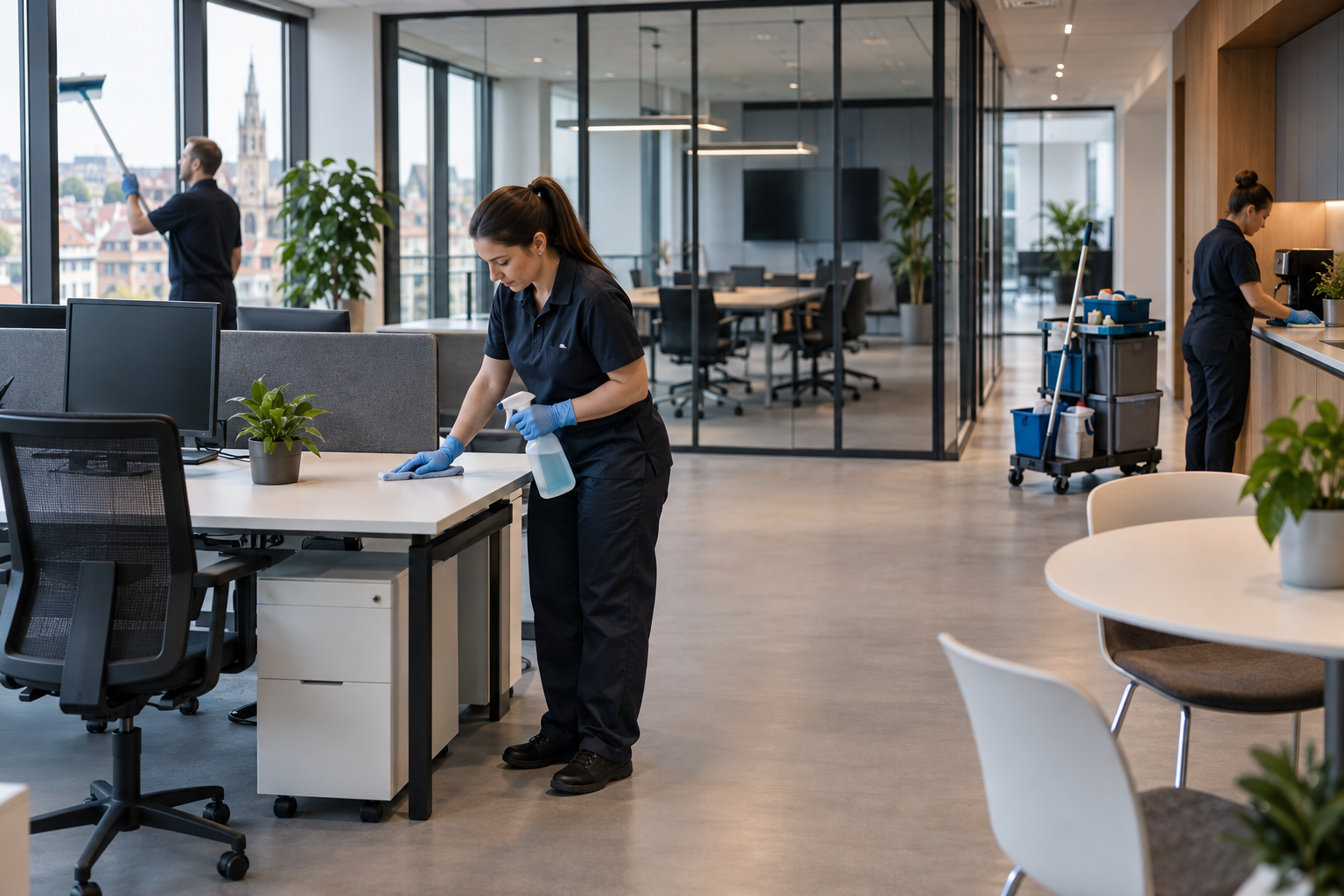
During the day: more direct coordination. Having someone on site during working hours facilitates communication and allows for addressing needs that arise during the shift—such as depleted supplies, high usage of restrooms, or dirt in the entryway. It also prevents the need, when access is supervised, to have the service provider open or close the facility on their own.
On the other hand, cleaning must follow a specific procedure. We clean in an empty room, not in the middle of a meeting. We avoid vacuuming near occupied workstations. And the lunch break isn’t necessarily a good time to clean: that’s often when the kitchen is busiest.
In the evening: more freedom, provided that the offices actually empty out. This model makes it easier to manage common areas and shared spaces without interrupting work teams. It becomes less effective in a company where staff departures are unpredictable. Closing up requires a clear protocol: checking the areas, reactivating the alarm system, and knowing what to do if anyone is still working.
The best choice might be a combination of both. A primary cleaning shift outside of operating hours, supplemented by a targeted daytime cleaning session, is better suited to high-traffic locations than a single time slot imposed on all tasks.
Strategic Criteria for Making a Choice: From Security to Privacy
Who enters your premises, what access rights do they have, and what can that person see while on the job? These questions must be addressed before setting the schedule for a cleaning company. A practical schedule on paper is not enough if access security remains inadequate.
Grant limited access based on actual needs. When your system allows it, prioritize individual badges that are restricted to authorized areas and time slots. Establish formal procedures for issuing keys, returning them, and reporting a loss. A staff member’s replacement should trigger an update to access permissions, not an informal lending of badges among staff members.
Alarm management requires a concise, tried-and-true procedure. Who disarms the system? Who verifies that it can be rearmed? Who should be called if a door remains open or if an employee is still on site? The answers must be accessible to the response team, without leaving the codes exposed on a sheet visible to everyone. For lone workers, also establish an alert system tailored to the site’s risks.
Acoustic comfort is judged based on actual use, not just on the equipment's technical specifications. A vacuum cleaner marketed as quiet can still be heard in an office where people are conducting business over the phone. The sound of carts, chairs being moved, and conversations among employees also contribute to the noise level. To ensure employee comfort, noisy tasks should therefore be scheduled outside of sensitive times, and quiet maintenance should be reserved for occupied areas.
Confidentiality, however, does not disappear when employees leave the premises. Contracts remain on desks, screens are sometimes open, and information is displayed on meeting boards. Define which areas are accessible, which are off-limits, and the conditions for access to sensitive office areas. An ordinary trash can and a container for confidential documents do not follow the same route. Confidentiality agreements must be accompanied by practical guidelines, including a prohibition on taking photographs without authorization.
To clean offices properly, three operational rules provide a solid foundation: move from clean to dirty areas, work from top to bottom, and avoid cross-contamination by using different cleaning supplies for different zones. These are not three universal rules that would replace a protocol. They must be supplemented by proper use of cleaning products, care for surfaces, and adherence to drying times. Discretion never justifies skipping these steps.
The Service Provider’s Adaptability: The Secret to a Smooth Cleaning Experience
A rigid schedule quickly becomes outdated in offices where staff attendance changes every week. Remote work, training sessions, client visits, and office renovations all alter needs. True flexibility means accommodating these changes systematically, not improvising each time.
The first step is a tour of the premises and a discussion about how they are used. Floor space alone is not enough to plan the cleaning of business premises. You need to know the number of people present, high-traffic areas, floor coverings, sensitive areas, and equipment storage constraints. A small kitchen used all day long may require more attention than a large room that is rarely occupied.
This observation is used to develop a plan for each area: expected tasks, frequency, time frame, and restrictions. In a shared workspace, noisy activities may take place before the teams arrive. Restrooms may be cleaned during the day, while a training room will be cleaned after the participants have left. Every cleaning task has a specific purpose and a specific time.
What cleaning routine should be followed during work hours? Focus on specific areas rather than doing a general cleanup in the midst of employees. Check supplies, address localized messes, and maintain areas that are temporarily unoccupied: these steps keep the space clean without causing frequent interruptions. Cleaning a walkway, on the other hand, requires clear markings and organization to ensure a safe path remains open.
At KHOMCLEAN, scheduling adjustments must be based on these practical constraints. B2B expertise involves distinguishing between what can be rescheduled and what requires action at a specific time, and then agreeing on the terms of the change. Work together to specify the request channel, the notice period, and the options for reorganization. Flexibility does not mean unlimited availability; it means establishing a framework that is clear enough to avoid unpleasant surprises.
Service quality is then assessed based on observable results: restrooms restocked, no traces left behind, tasks completed, incidents reported, and compliance with restricted areas. Having a designated point of contact and a simple system for tracking discrepancies prevents the Office Manager from having to repeat the same instructions over and over. When a replacement is brought in, the new staff member should be able to access these instructions without relying on their colleague’s memory.
Finally, schedule a follow-up after the first few weeks. If the residents consistently run into the cart in the entryway, the route needs to be adjusted, even if the schedule has been followed.
Conclusion
First, identify the constraints that your organization cannot accommodate. A sales team handling continuous calls will have a hard time dealing with noisy operations during the day. A site without an automated access procedure should not switch to evening hours until it has completed its closing procedures. Offices containing sensitive information require a clearly defined scope of work, regardless of the schedule chosen.
The morning is a good time if opening hours are predictable and allow for sufficient working time. The daytime works well when tasks can be scheduled around the use of the spaces. The evening offers true flexibility if departures and security procedures are well managed. No amount of time management can make up for poor organization. Conversely, a well-designed combination can address everyone’s limitations without complicating the teams’ day-to-day work.
Before finalizing your office cleaning service, prepare a typical weekly schedule rather than just a list of times. Include recurring meetings, days with high foot traffic, deliveries, and times when the reception area must remain spotless. Add any known exceptions, such as a late monthly meeting or a training session that takes up multiple rooms. The service provider will then be able to propose a realistic schedule.
To compare proposals, ask for verifiable answers on four points:
-
Scope: What tasks are performed in each area, and how often?
-
Responsibilities: Who is responsible for access control, alarms, and reporting anomalies?
-
Adjustments: How do you reschedule an assignment when an event changes the occupancy?
-
The inspection: How are discrepancies identified, corrected, and tracked?
These factors allow you to base your decision on the organization’s reliability, not on a vague promise of discretion. Your team shouldn’t have to oversee every step of the process just to get clean facilities.
Discuss your actual schedules, sensitive areas, and operational requirements with KHOMCLEAN. The goal is to design a layout that is tailored to your space, with efficient operations and as few disruptions as possible for the occupants.
Frequently Asked Questions
How do you choose between having your office cleaned in the morning, during the day, or in the evening?
The morning is a good time if arrivals are regular and if there is enough time to finish cleaning and drying before opening. During the day, cleaning must be scheduled based on the availability of spaces; in the evening, it requires sufficiently predictable departure times and a well-managed closing process. To make a decision, compare your actual occupancy schedules, your noise-sensitive periods, and your access constraints rather than relying solely on the schedules posted at the front desk.
What precautions should be taken if cleaning takes place outside of staff hours?
Before deciding on morning or evening shifts, determine who will arm and disarm the alarm, check the premises, and ensure they are secured. Limit access to what is strictly necessary, establish a formal key handover procedure, and—when the system allows—issue individual badges with appropriate access permissions. The team must also know who to contact in the event of an open door, an employee still on the premises, or an issue related to working alone.
Is it possible to clean the offices during the day without disrupting phone calls and meetings?
Yes, provided that quiet tasks are reserved for occupied areas and noisy tasks are scheduled outside of sensitive times. A vacuum cleaner marketed as quiet is still audible, as are carts or the movement of chairs; therefore, the route should follow unoccupied rooms and address specific needs as they arise. The lunch break is not automatically available, especially in a kitchen that is very busy at that time.
Does cleaning in the evening provide better protection of office privacy?
Not just that: even after the teams have left, contracts may still be left on desks, screens may be open, and information may be visible on whiteboards. Regardless of the time slot, define which areas are accessible, which are off-limits, and the rules for working in sensitive office areas. The guidelines must also distinguish between regular wastebaskets and bins for confidential documents and prohibit unauthorized photography.
When should you combine a deep cleaning while the premises are unoccupied with a daytime cleaning visit?
A hybrid cleaning schedule is particularly well-suited for high-traffic locations, where a single cleaning run is insufficient to meet needs throughout the day. The main cleaning can take place before staff arrive or after they leave, with a targeted cleaning session for consumables, restrooms, or localized messes. This combination allows for separating disruptive operations from occasional maintenance tasks, without having to conduct a general cleaning while employees are present.
How can you use KHOMCLEAN to organize schedules that accommodate remote work and events?
Plan a typical week that includes days with high foot traffic, recurring meetings, client visits, and known exceptions, then use the site visit to specify the needs by area. With KHOMCLEAN, agree on the request channel, the notice period, and options for reorganization: flexibility is based on a shared framework, not on unlimited availability. A follow-up meeting after the first few weeks then allows you to adjust any time slots or routes that aren’t working well.


 Français de Belgique
 English
 Nederlands (België)
0 Comments