


Office Cleaning in Belgium: Organizing Your Services
Table of Contents
Restrooms that are spotless when the office opens, but already out of soap by noon. A meeting room cleaned on Friday, even though it hosts your clients on Thursday. These discrepancies often reveal a scheduling problem, not just an execution issue. To organize office cleaning in Belgium, you need to start by considering how the spaces are used, rather than applying the same service everywhere.
Key Takeaways
-
This content serves as a foundational pillar page
-
It goes beyond a simple inventory to provide a method for organizing by zone (workstations, restrooms, kitchen) and helps determine the frequency of cleaning based on actual use of the premises and visitor traffic, which is typical of the Belgian B2B market
-
define services by work area
-
Compare the different options before making a decision.
Services, frequency, and organization: these three factors must work together. Here’s a method for determining the needs of each area, tailoring cleaning services to your actual occupancy, and preparing a set of specifications that a service provider like KHOMCLEAN can use. The goal: regular, manageable cleaning without an increase in last-minute requests.
Selection Criteria: Defining Services by Work Area
Do your individual offices and your communal kitchen really require the same level of maintenance? No. Each space has its own types of dirt, access constraints, and high-touch areas. A proper definition of cleaning services therefore begins with a tour of the premises, area by area, with the person who understands how they operate on a daily basis.
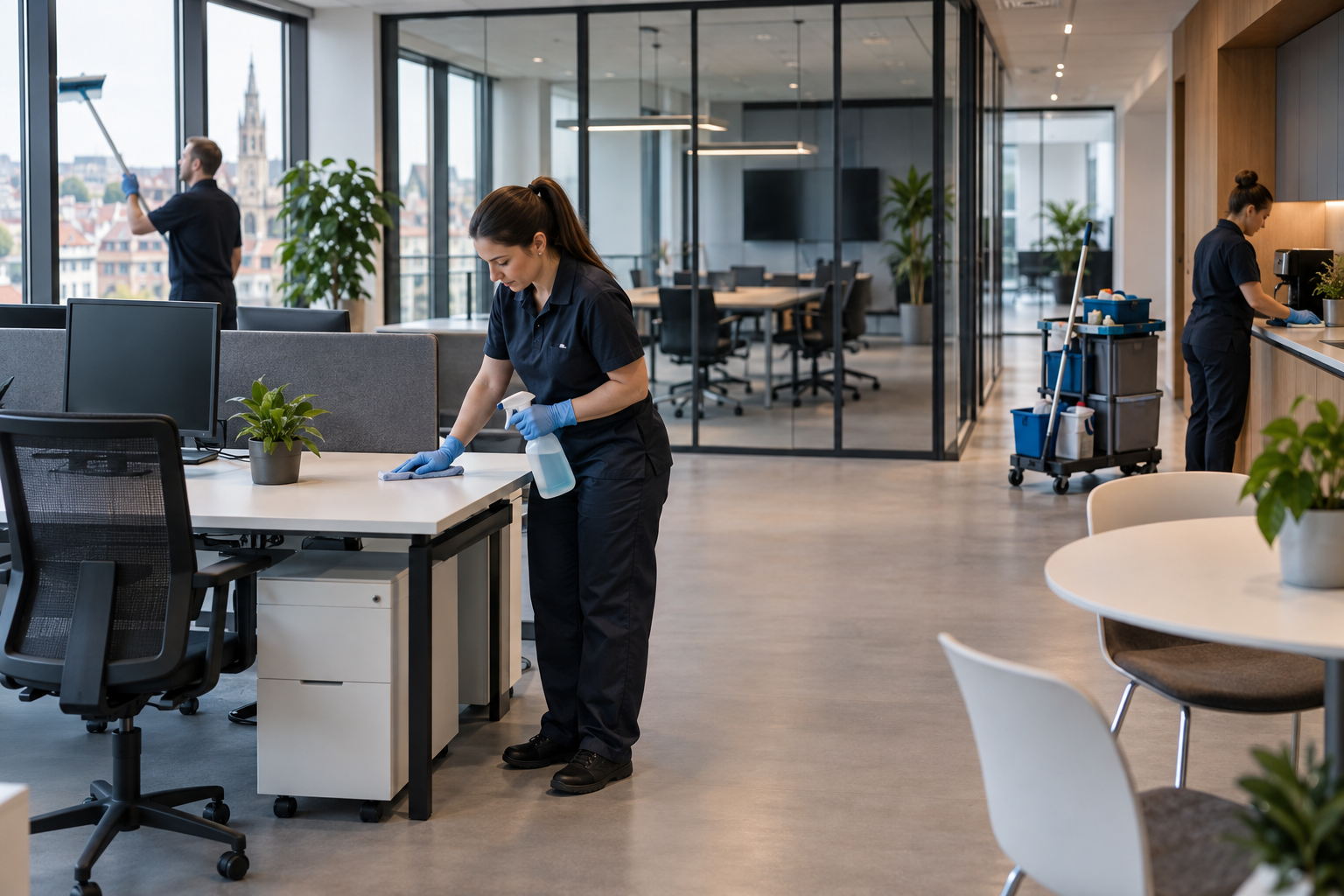
For each area, specify the surfaces to be treated, the required procedures, and the scope of work. «Office cleaning» is still too vague to constitute a verifiable commitment. «Wiping down clear work surfaces, emptying trash cans, and vacuuming hallways» already provides a clear framework for the work.
-
Positions and work areas: Plan to dust accessible surfaces, keep offices tidy, and collect waste according to your recycling guidelines. Establish separate procedures for handling phones, keyboards, and monitors, using methods compatible with the equipment. Confidential documents must not be moved without specific instructions.
-
Restrooms: Provide detailed instructions for cleaning toilets, sinks, faucets, mirrors, handles, and floors. Include checks on soap, paper, and hand towels. A room that looks clean but lacks supplies does not serve its purpose.
-
Kitchen and dining area: Make a clear distinction between cleaning countertops, sinks, tables, and cabinet fronts, and cleaning the inside of the refrigerator or microwave. Who throws out expired food? Who puts the dishes away? These tasks require an explicit agreement.
-
Lobby and meeting rooms: Focus on cleaning marks on accessible glass surfaces, tables, high-touch areas, and floors. The cleaning schedule should take appointments into account, not just regular business hours.
Floor maintenance warrants a specific description. Carpet, hardwood floors, and resilient flooring do not tolerate the same levels of moisture or the same cleaning products. Have the materials and their condition documented before beginning work. Stain removal, injection-extraction, and restoration must be distinguished from routine cleaning.
We can organize these needs into three practical categories: Routine cleaning, deep cleaning, and targeted disinfection. This is not a universal classification. Its main purpose is to help distinguish between the removal of dirt and microbiological control. In tertiary hygiene, systematic disinfection of all surfaces is not an end in itself: it is justified based on the risk and complies with the product’s instructions for use, particularly its contact time.
Maintenance Frequency: Adjust the Schedule to the Company's Workflow
Having 40 employees on the company’s roster does not mean that 40 people are present every day. With remote work, travel, and off-site meetings, occupancy can vary significantly throughout the week. Basing the cleaning frequency solely on headcount leads to certain areas being cleaned too often, while those with the highest foot traffic are not cleaned often enough.
For two representative weeks, track the number of employees present, days of operation, visitors, and internal events. This sample serves as a starting point, which should be supplemented if your business experiences seasonal peaks. No need for a complex system: a daily record for each major area is sufficient to prepare an initial schedule.
Let’s consider an illustrative example: a company has 12 people in the office on Monday, 35 on Tuesday, and 8 on Friday. Its large meeting room also hosts visitors on Tuesday afternoons. The schedule must prioritize shared areas on Tuesdays without neglecting the necessary cleaning of restrooms on other busy days.
-
Bathrooms and kitchen: Plan for daily maintenance on days the equipment is in use, with additional checks of consumables and cleanliness if the workload requires it.
-
Workstations: Allocate workstations based on actual occupancy, office sharing arrangements, and storage guidelines. A cluttered workstation is difficult to keep clean.
-
Entrances and hallways: Adjust vacuuming or mopping based on foot traffic and the level of dirt. On rainy days, it may be necessary to pay closer attention to entryways and rugs.
-
Meeting Rooms: Plan to tidy up after making reservations, especially after a meal or before welcoming guests.
-
In-Depth Operations: Schedule less frequent tasks based on the observed condition, the materials, and maintenance recommendations, rather than on an arbitrary schedule.
The frequency of office cleaning should be flexible. Plan to conduct a review after the first month: complaints, missing supplies, stubborn stains, and underused areas. These observations will allow you to adjust the cleaning schedule without waiting for the contract to be renewed.
That leaves the question of scheduling. Work done during the day facilitates communication, but requires managing noise, traffic, and marking wet floors. Work done before opening or after closing requires reliable procedures for keys, access badges, and the alarm system. The ideal time slot is one that allows you to complete all tasks without disrupting your operations or compromising security.
Pre-Purchase Recommendations: Outline Your Requirements
A detailed quote cannot make up for an ill-defined need. Before consulting service providers, prepare a set of cleaning specifications that everyone agrees on. This will allow you to compare equivalent service offerings, rather than discovering after signing the contract that windows, supplies, or replacements were excluded.
This document can be brief. Above all, it should describe the expected layout and allow you to verify that the maintenance of the business premises is being carried out as agreed. Attach a floor plan if you have one, clearly indicating the areas that are actually accessible and those occupied by furniture or storage.
-
Describe the site: area-by-area floor plans, floor coverings, staff on duty, visitors, hours of operation, and sensitive areas. Include any access restrictions, particularly for the archives and technical facilities.
-
List the tasks: Assign each service to an area and a frequency. Separate recurring services, periodic tasks, and one-time requests.
-
Assign responsibilities: Specify who supplies the products, equipment, and medical supplies. For restocking, indicate who monitors inventory levels, who places orders, and who refills the dispensers.
-
Outline the practical steps: Access to water, secure storage of equipment, waste management, ID badges, locking doors, and alarm procedures. None of these points should be left to chance on the first visit.
-
Define the control: Appoint a point person on each side, establish the procedures for reporting issues, and agree on a timeframe for resolving them. A brief checklist for each area is better than a report that’s impossible to use.
To understand the hourly rate or pricing structure of a cleaning company in Belgium, ask what the quote actually covers: supervision, equipment, cleaning supplies, any travel expenses, and recurring services. An hourly rate on its own does not describe either the scope or the expected outcome. Also check how additional work and schedule changes are handled, without limiting yourself to the total amount of the estimate.
Wage issues, on the other hand, fall under the social framework applicable to the service provider. For a company covered by Joint Commission 121 for the cleaning industry, pay scales depend in particular on the job category and the current index adjustments. Verification of these rates must be based on up-to-date official sources, not on an average found online.
Finally, ask for the relevant insurance documentation, provisions for coverage in case of absence, and confidentiality procedures. The organization of commercial cleaning relies on service continuity. Your Office Manager shouldn’t find out about a missed area only when they receive the first complaint of the morning.
Conclusion
The best indicator of a well-organized maintenance operation is the number of problems your teams no longer have to deal with. No empty dispensers, no tasks that were supposed to be included but weren’t, no blocked access due to missing badges. This reliability is established before the first service call, with a clear scope of work and assigned responsibilities.
To move from intention to action, follow these steps in this order:
-
Validate the requirement internally. Have the expectations reviewed by the people who use the spaces, without turning every individual preference into a contractual obligation. Actual usage should take precedence.
-
Schedule a visit with the service provider. Point out the constraints that are difficult to deduce from a floor plan: crowded furniture, narrow passageways, fragile surfaces, early morning deliveries, or late-night meetings.
-
Check for any discrepancies between your request and the offer. You must understand all exclusions before signing. If there is a task you are still responsible for, assign it to someone else.
-
Prepare for the launch. Let your employees know about the time slots, the expected desk organization, and the channel to use for reporting a problem.
-
Schedule an initial review. Set a date to review the results and decide on any adjustments, rather than letting an ineffective system take hold.
Allow for room to accommodate foreseeable changes: the arrival of a new team, construction work, a client event, or a new remote work policy. The contract must specify how to request an adjustment and who can approve it. Without this process in place, informal requests end up blurring priorities and making it difficult to track them.
Your choice should therefore not be based on a general promise of cleanliness. Look for a service provider capable of translating your requirements into specific tasks and then following through on them. It is this discipline that makes the service unobtrusive on a day-to-day basis and reliable over the long term.
Are you planning to have your offices in Belgium cleaned? Contact KHOMCLEAN with your floor plan, your days of occupancy, and your main constraints. These details will enable us to have a concrete discussion about the services to be provided, the appropriate frequency, and the intervention procedures best suited to your company.
Frequently Asked Questions
What tasks should be planned for each area of the office?
Define the services area by area: accessible surfaces and trash cans at workstations; equipment and supplies in restrooms; countertops and sinks in the kitchen; and tables and floors in meeting rooms. Specify separately the cleaning of computer equipment, the interiors of kitchen appliances, and specific care for floor coverings. Putting away dishes or removing expired food requires explicit agreement.
How do you determine how often to clean when teams are working remotely?
For two representative weeks, track attendance, visitors, and events by day and by major area, rather than relying solely on total headcount. Consider cleaning the restrooms and kitchen daily on days when they are in use, then adjust the frequency of other cleanings based on actual occupancy and room reservations. A review after the first month will allow you to adjust the cleaning schedule based on any issues identified.
Should all surfaces be disinfected every time you go through?
No, systematic disinfection of all surfaces is not an end in itself for offices; it is justified based on the risk. Distinguish between routine cleaning, deep cleaning, and targeted disinfection, as removing dirt and ensuring microbiological control serve different purposes. When disinfection is planned, the product’s instructions for use—particularly its contact time—must be followed.
Is it better to have the offices cleaned during the day or after hours?
Cleaning during the day makes it easier to coordinate with the service provider, but requires managing noise, foot traffic, and marking wet floors. Cleaning before opening or after closing requires clear instructions regarding keys, access badges, and the alarm system. Choose a time slot that allows all tasks to be completed without disrupting operations or compromising security, while also taking client appointments into account.
How can you compare office cleaning quotes in Belgium beyond just the hourly rate?
Provide the same scope of work to each service provider, including the areas, tasks, frequency, and expected responsibilities. Next, verify that the proposal covers supervision, equipment, products, supplies, any travel expenses, and periodic operations: the hourly rate alone does not fully describe the service. Also, have the service provider clarify any exclusions, how additional services will be handled, and the conditions for schedule changes before signing.
How can you avoid empty dispensers and missed cleaning cycles?
Clearly assign responsibility for monitoring inventory, ordering supplies, and restocking dispensers, with additional oversight if foot traffic warrants it. Establish procedures for covering absences and designate a point of contact on each side to report issues, with an agreed-upon response time. A brief checklist for each area and an initial review after one month will allow you to fine-tune the organization.


 Français de Belgique
 English
 Nederlands (België)
0 Comments