



Professional Window Cleaning in Belgium: Expertise and Frequency
Table of Contents
-
Professional vs. Occasional Cleaning: Guaranteed Streak-Free Results
-
Expert Techniques: From Traditional Scraping to Reverse Osmosis Water
A spotless window display on opening day, only to be marred by fingerprints and splatters the very next day: many businesses face this problem. In offices and buildings, dirt and grime may not be noticed as quickly. Eventually, however, it impairs visibility, reduces natural light, and negatively affects the impression visitors get.
Key Takeaways
-
A flagship article positioning KHOMCLEAN as the B2B expert
-
This approach highlights the difference between occasional service and technical expertise (reverse osmosis water, safety), while guiding the customer on the optimal frequency based on their industry
-
a guarantee of streak-free results
-
Compare the different options before making a decision.
Professional window cleaning in Belgium involves more than just running a squeegee across the glass. The methods, frequency, and maintenance must be considered together, with careful attention paid to access and the building’s operations. A window accessible from the ground and a glass facade above a busy entrance do not require the same resources or the same organizational approach.
For KHOMCLEAN, the goal of B2B window cleaning is simple: to achieve a clean, consistent result that fits seamlessly into your daily operations. Here are the technical and practical criteria to consider when choosing the right service and scheduling it without creating unnecessary visits.
Professional vs. Occasional Cleaning: Guaranteed Streak-Free Results
How can you tell if a window has been cleaned really well? Not just by how it looks right after cleaning. Look at it once it’s dry, in low-angle light: streaks from the squeegee, cleaning product residue, and streaks running down from the edges will then become visible. Professional quality is judged by the final result, not by how quickly the work is done.
Occasional cleaning can be excellent when performed by a specialist. The difference from a regular cleaning contract is therefore not a matter of expertise, but of consistency. After a construction project, before an opening, or following a long period without maintenance, a one-time cleaning service addresses a specific need. Regular cleaning, on the other hand, allows the cleaning staff to become familiar with the building, its entrances, and the areas that get dirty the fastest.

The work begins before wetting the glass. You must identify the surfaces, locate any films or coatings, check for access restrictions, and distinguish between common dirt and specific deposits. Traces of adhesive, paint splatters, or mineral deposits should not be treated the same way as fingerprints. Using an abrasive or a blade without first checking the substrate’s compatibility can cause irreversible scratches.
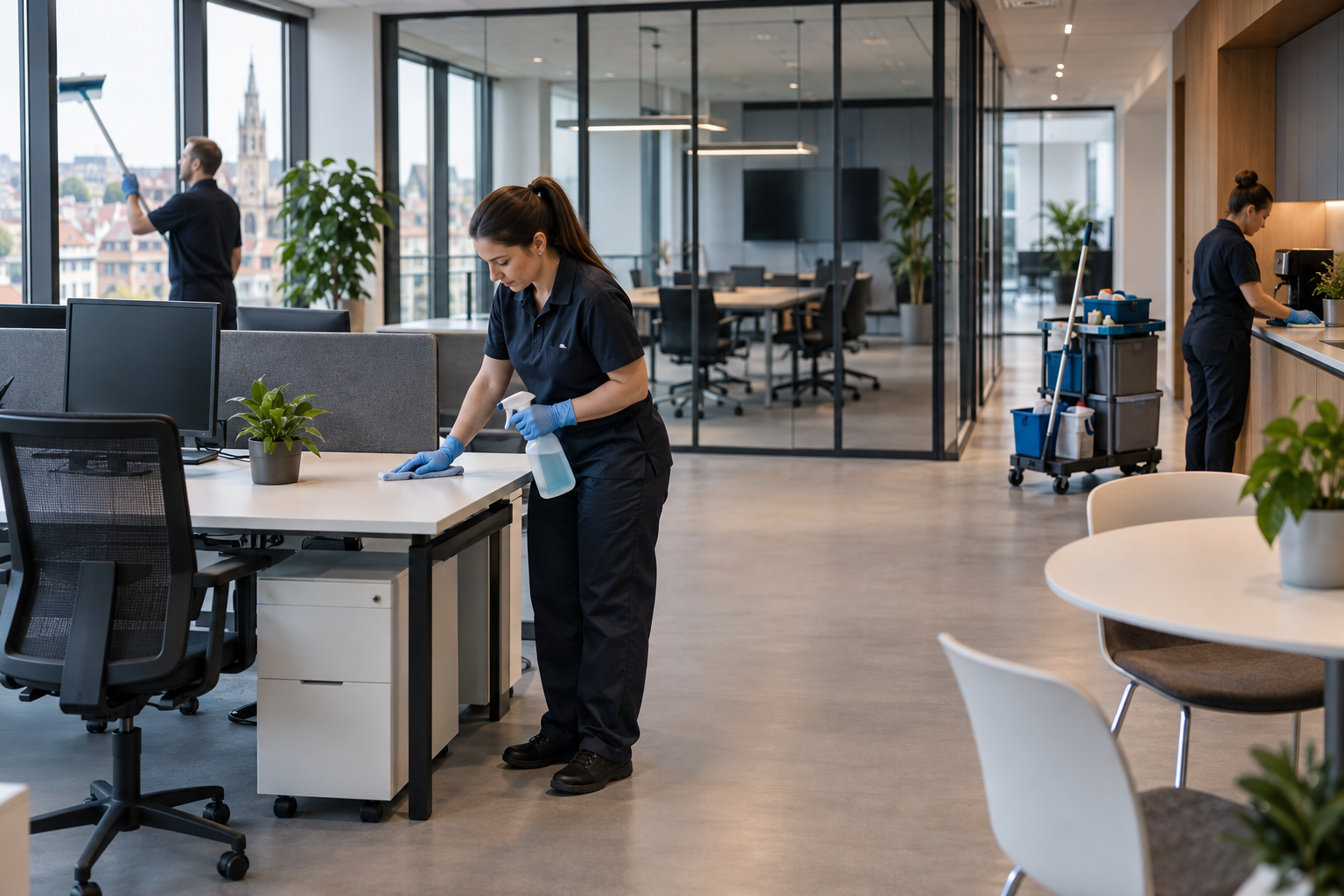
Organization is just as important as the action itself. In a retail store, priority is given to a spot that minimizes disruption in front of the display window. In offices, access to windows is planned without unnecessarily moving occupants’ belongings. For a condominium, the property manager must know which common areas will be affected and whether private access is necessary.
-
Define the scope: interior and exterior surfaces, glass doors, partitions, door frames, and window sills, as specified in the agreed-upon scope of work.
-
Prepare the surrounding area: Protect sensitive surfaces, clear access points, and manage traffic flow.
-
Check the finish: Check the corners, edges, and any drips after drying.
Workplace safety is not an optional extra. A wet floor in a lobby, a pole near a walkway, or work being performed above an entrance all require appropriate precautions. Signage, user protection, and the selection of equipment are all part of the service.
To compare quotes for professional window cleaning, ask for a clear description of the work rather than just a total surface area. The height, accessibility, initial condition, and items included determine the resources required. Two quotes that don’t cover the same tasks aren’t truly comparable.
Expert Techniques: From Traditional Scraping to Reverse Osmosis Water
Two glass surfaces that look identical may require different cleaning methods. An interior partition with electrical outlets nearby must be cleaned with strict control over water use. An exterior facade accessible from the ground, on the other hand, may be suitable for cleaning with purified water. The most effective method is the one that is appropriate for the surface, the type of dirt, and accessibility.
The wiper-and-squeegee combo remains the gold standard for display cases, doors, and accessible interior windows. The wiper loosens dirt with a properly diluted solution, and then the squeegee removes the soiled water. The edges are finished with a clean, suitable cloth. Too much cleaner leaves a film; a worn or damaged rubber blade leaves streaks. The equipment is simple, but the result depends heavily on its condition and the consistency of the technique.
Osmosis water follows a different principle. Reverse osmosis removes a large portion of the dissolved salts; depending on the system and the desired water quality, additional deionization can further refine this purification process. With sufficiently pure water, proper brushing, and thorough rinsing, the glass can dry without wiping, minimizing the mineral deposits that cause streaks.
This technique is used in particular with water-fed telescopic poles. They allow you to clean certain high surfaces while remaining on the ground. However, this is not a one-size-fits-all solution: the distance from the facade, obstacles, wind, the type of window frames, and the ability to properly scrub the entire surface remain key factors. Clogged joints can also release dirt during rinsing.
When working at heights, the choice isn’t just about the length of a pole. You must assess the work area, weather conditions, and access methods. When working from the ground isn’t feasible, an aerial work platform or other equipment may be necessary. Safety when working at heights depends on a risk assessment, trained personnel, and appropriate protective equipment, in accordance with applicable requirements in Belgium.
One point deserves to be made clear: purified water is not always a substitute for a specific treatment. Old lime scale deposits, sticky residues, or certain greasy stains require a diagnosis and, if necessary, a product compatible with the glass. For treated or film-coated glass, the manufacturer’s recommendations take precedence over cleaning habits.
Expertise consists precisely of selecting and then verifying. A technique that is mastered well yields good results within its intended field of application; applying it indiscriminately, without inspecting the building, is poor practice.
Plan Your Maintenance Schedule to Enhance Your Brand Image
Every two weeks for a storefront, every two months for certain office windows: these schedules can serve as starting points, not absolute rules. The frequency of cleaning depends primarily on exposure and the expected standard of presentation. A retail entrance on a busy street does not have the same needs as an office facade facing a quiet courtyard.
Brand image is particularly influenced by the surfaces that visitors see up close. A door with marks at handle height or a smudged display window immediately draws attention. Conversely, cleaning all sides of all windows at the same rate can tie up resources where they are of little use. It is better to differentiate between zones than to choose a uniform frequency simply for the sake of convenience.
Here are some guidelines to be adjusted after assessing the site:
-
Stores and showrooms: Consider cleaning the display cases weekly or every two weeks when sales volume is high, with spot cleaning as needed.
-
Offices: Start by cleaning the exterior every four to eight weeks in an exposed environment, then adjust the frequency based on the amount of dirt buildup observed.
-
Restaurants and establishments open to the public: Frequently check doors and windows near tables, walkways, or areas where splashes may occur.
-
Condominiums: Schedule regular inspections of lobbies and glass doors; windows in stairwells, which see less traffic, can follow a separate schedule.
-
Industrial sites: Determine the maintenance frequency based on dust levels, nearby emissions, and operating conditions.
In Belgium, the weather mainly requires adaptation. Rain alone does not dirty every window the same way: it can carry dust from the building’s facade and cause streaks. Wind also carries particles, while pollen, a nearby construction site, or sea spray in coastal areas temporarily change cleaning requirements. Systematically waiting for a long dry spell is not a reliable maintenance strategy.
To determine the right frequency, observe the time between cleanings and the point at which the appearance becomes inadequate for your business. Assess this over two or three cycles, distinguishing between the interior and exterior. This approach makes window cleaning more precise: you’ll focus on the areas that make a difference and avoid those that don’t result in a visible improvement.
The schedule must also account for exceptions: store openings, client visits, construction work, or events. A recurring schedule that allows for adjustments is more effective than a series of urgent requests.
Conclusion
Keep this selection criterion in mind: a specialized service provider should be able to explain what they clean, how they access those areas, and why they recommend a certain frequency. An answer limited to «we clean all the windows» isn’t enough when organizing the maintenance of a commercial building. You need a clear scope of work and a service plan that fits your specific needs.
The squeegee remains perfectly suitable for many surfaces. Osmosis water offers an advantage on facades that are suitable for it. Specialized access methods are designed for more complex situations. These are tools used to achieve results, not factors to be considered in isolation from the specific site conditions. The priority remains clean glass, without damaging the surface and without unnecessarily exposing workers or occupants to risk.
Before contacting KHOMCLEAN for professional window cleaning services in Belgium, gather some useful information. You don’t need to prepare a complete technical report yourself: a description of the building and any known constraints is enough to help us understand your needs.
-
Please specify the intended use of the premises and the time slots during which work would cause the least disruption to your operations.
-
Please specify the areas involved, the floors, and any access difficulties you have identified.
-
Please note any films, special treatments, old stains, or recent work done on the windows.
-
Distinguish between your immediate need and a potential request for routine maintenance.
Photos can facilitate this initial discussion, though they should not replace an on-site inspection when the situation calls for one. Next, ask for a clear list of what is and isn’t included: frames, supports, interior surfaces, special access points, or initial restoration. This clarification prevents many misunderstandings during the project and makes it easier for your teams to follow up.
Contact KHOMCLEAN to discuss your needs and develop a maintenance program tailored to your facility. The goal isn't to schedule as many visits as possible. It's to maintain the expected level of cleanliness—in the right places and at the right time—with a system that you don't have to set up from scratch for every appointment.
Frequently Asked Questions
Can a one-time cleaning be as thorough as regular maintenance?
Yes, a one-time cleaning service performed by a specialist can yield excellent results, especially after construction work or before a grand opening. The benefit of regular maintenance lies primarily in consistency: the service provider is familiar with the building’s access points, its specific constraints, and the areas that get dirty quickly. In both cases, the quality can be assessed after the surface has dried by examining the edges, drips, and streaks under low-angle light.
Does reverse-osmosis water clean windows better than a squeegee?
Not in all situations: the squeegee is still suitable for storefronts, doors, and accessible interior windows, while reverse-osmosis water is beneficial for certain exterior facades. Sufficiently pure water, combined with proper brushing and thorough rinsing, allows for drying without wiping by minimizing mineral deposits. However, it does not always replace a specific treatment for old limescale deposits, adhesive residues, or certain greasy stains.
How often should the windows of a retail store or office be cleaned?
For a heavily exposed storefront, cleaning once a week or every two weeks is a good starting point; for exterior office windows in exposed environments, the guideline is every four to eight weeks. These schedules should be adjusted after two or three cycles, depending on how long it takes before the windows become too dirty. Distinguishing between interior and exterior surfaces, as well as heavily used doors, prevents cleaning all surfaces unnecessarily at the same frequency.
Is a telescopic pole enough to clean all the high windows?
No, its use depends, in particular, on the distance from the facade, any obstacles, wind conditions, and the ability to properly clean the entire surface. If working from the ground is not feasible, a cherry picker or other equipment may be necessary. The decision must be based on a risk assessment, with trained personnel, appropriate protective equipment, and safety markings that also protect people passing by the work site.
Do you have to wait for several days of good weather to have your windows cleaned in Belgium?
Routinely waiting for a long dry spell is not a reliable maintenance strategy: rain can wash dust off the facade and cause streaks, but it does not soil all windows in the same way. Wind, pollen, a nearby construction site, or sea spray can also affect cleaning needs. The cleaning schedule should therefore be adjusted based on the observed level of soiling, while taking weather conditions into account to ensure safety during the work.
What information should I provide to KHOMCLEAN to get a quote tailored to my building?
Specify the intended use of the premises, the least disruptive times, the areas involved, the floors, and any known access difficulties, then note any coatings, special treatments, or old stains. Photos can facilitate the initial discussion, though they should not replace an on-site inspection if necessary. To compare quotes, request a clearly defined scope of work that includes or excludes interior and exterior surfaces, window frames, sills, special access points, and any necessary initial repairs.


 Français de Belgique
 English
 Nederlands (België)
0 Comments