


Parking Lot Cleaning: Expertise Beyond the Scrubber-Dryer
Table of Contents
-
Routine Maintenance vs. Major Renovation: Determining Your Parking Garage's Actual Needs
-
The Scrubber-Dryer Faces Real-World Challenges: Why a Mechanical-Only Approach Falls Short
-
Audit and Specifications: Criteria for Choosing a Trusted Service Provider
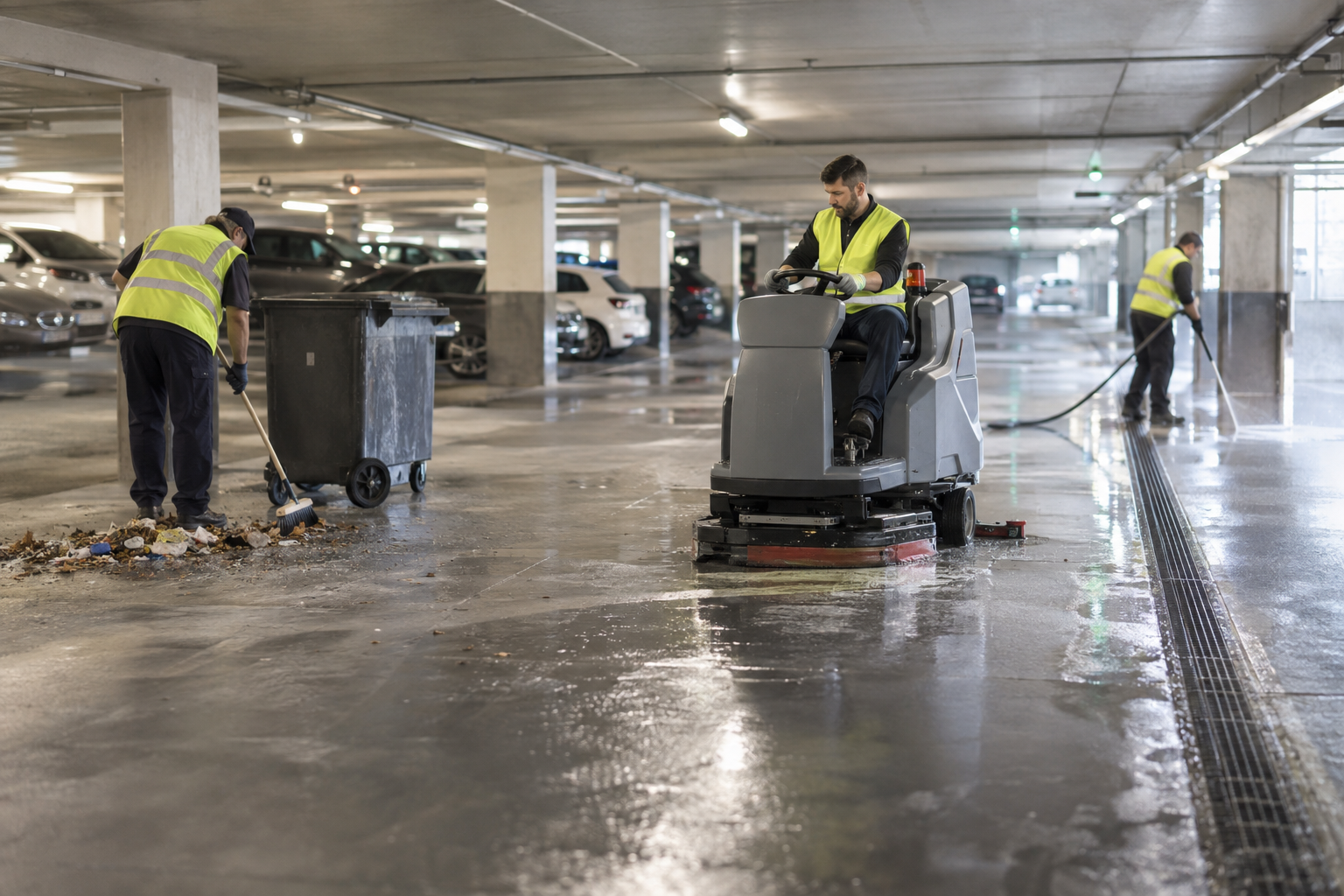
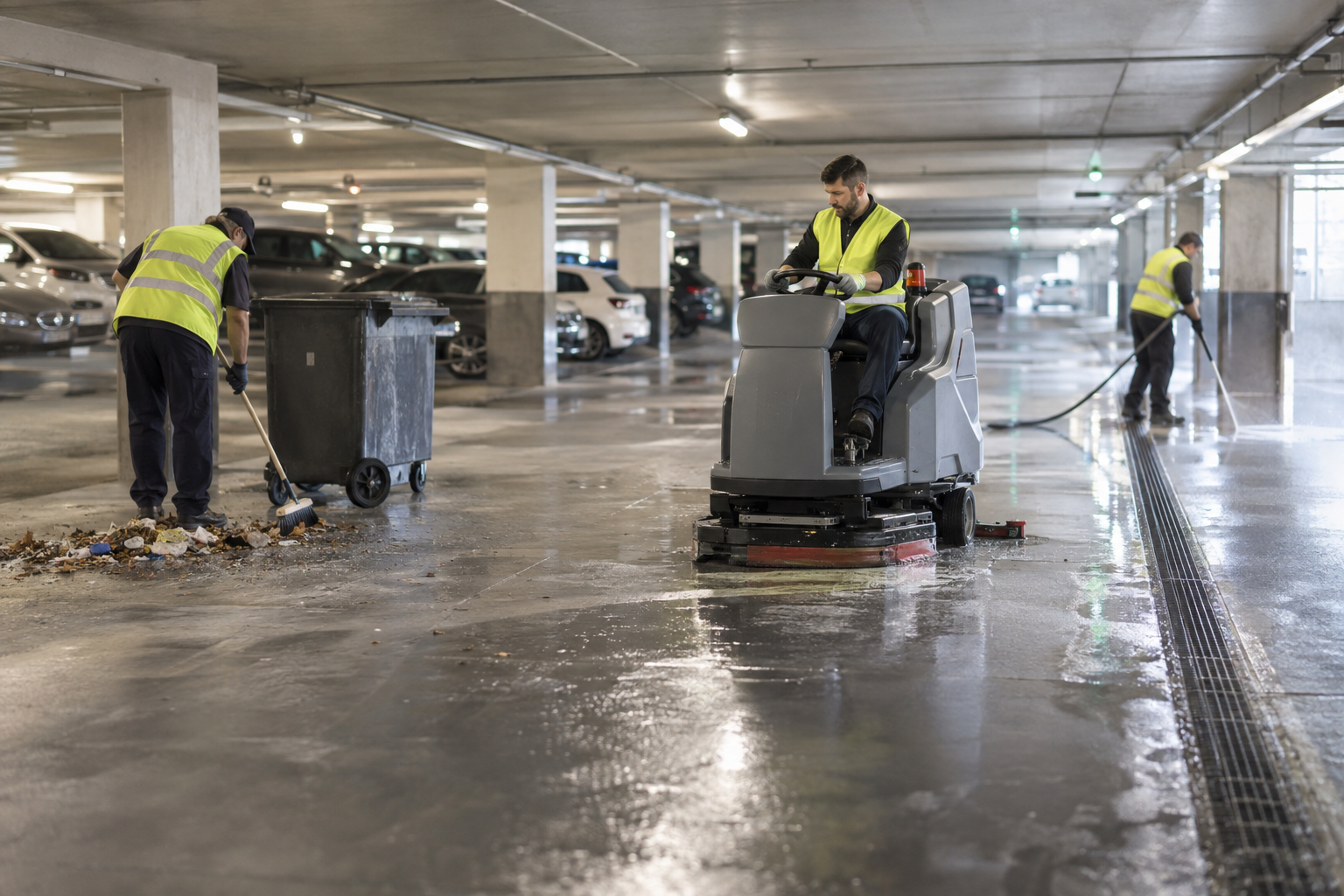
A still-damp floor, a few faint tire tracks, a sense of cleanliness: the passage of a machine can give the impression that the work is done. Yet, debris sometimes remains under vehicles, drain grates are clogged with sand, and discarded items still lie in the same spots. The parking lot has been washed. But that doesn’t necessarily mean it’s been maintained.
Key Takeaways
-
Dispelling the myth of the single pass by promoting a comprehensive technical approach
-
KHOMCLEAN outlines a rigorous methodology that includes waste disposal and bulky item management to ensure long-lasting results for facility managers
-
Determine your actual parking needs
-
Compare the different options before making a decision.
A Professional Parking Lot Cleaning must address all of these issues, not just the surface area accessible to brushes. For a property manager or site manager, the challenge is to ensure that walkways are usable, floors are properly cleaned, and the cleaning process does not leave difficult tasks for the facility manager to handle. The approach advocated by KHOMCLEAN is based on this principle: defining the need, preparing the premises, treating the dirt, and organizing its removal through to completion.
Routine Maintenance vs. Major Renovation: Determining Your Parking Garage's Actual Needs
Does your parking lot need regular maintenance or a complete overhaul? The answer doesn’t depend solely on its color. Dark concrete may look clean but be deeply stained; a visually clean resin surface may still have a slippery, greasy film. Before deciding on a cleaning frequency or machine, it’s important to distinguish between surface dirt, embedded deposits, and damage to the surface.
To clarify the need, we can distinguish between three levels of intervention. This breakdown is useful for comparing services, though it is not intended to be a universal classification of cleaning types:
-
Routine Maintenance : Waste collection, dust removal, and cleaning tailored to the site's foot traffic.
-
Enhanced Periodic Maintenance : targeted treatment of greasy areas, cleaning of curbs, the bases of poles, and areas that are difficult to reach on a daily basis.
-
Extensive restoration : More thorough cleaning of a parking lot that is caked with grime, has been neglected for a long time, or has become dirty after construction work, including the removal and treatment of accumulated deposits.
Parking lot restoration, therefore, is not a substitute for a maintenance program. It restores the site to a level of cleanliness that can then be maintained. Conversely, repeatedly giving a quick once-over to a layer of old grease mainly ends up wasting time without solving the problem.
The soil type This factor largely determines the method used. On porous concrete, oil can penetrate the surface and leave a stain even after cleaning. On resin, using a brush that’s too abrasive or an incompatible product may damage the finish. Asphalt also requires verifying the compatibility of degreasers and the methods used. Road markings, joints, and recent repairs must be taken into account, with a test on an inconspicuous area if necessary.
Let’s take an underground parking garage in an office building as an example: the ramp collects water carried in by tires, the parking spaces near the entrance accumulate sand, and certain areas remain occupied all week long. Applying the same cleaning frequency and treatment everywhere makes little sense. Floor maintenance must account for these differences in usage, with special attention paid to pedestrian walkways and areas where dirt builds up quickly.
The frequency is determined based on usage, exposure to the elements, and observations made between service visits. An inspection after the initial service visits allows for adjustments. This is more effective than a fixed schedule chosen without visiting the site.
Finally, we need to set a clear limit: Cleaning is not the same as repairing. A crack, peeling resin, or a slope that causes water to pool requires a different type of treatment. The service provider should report these defects rather than promise to fix them with a cleaning.
The Scrubber-Dryer Faces Real-World Challenges: Why a Mechanical-Only Approach Falls Short
The floor scrubber works well on a clear surface, with the proper settings and on dirt that it can actually remove. It applies a cleaning solution, performs mechanical action, and recovers the dirty water. However, it cannot move abandoned furniture, remove deposits from a drain, or reach every corner. Expecting it to do everything means accepting an incomplete result.
Cleaning with a floor scrubber-dryer therefore begins before the machine is started. You must direct traffic, clear the designated areas, and remove large debris. Gravel, pieces of cardboard, and plastic wrap can interfere with the brushes or the vacuum system. Heavy dust must also be removed using an appropriate method, rather than allowing it to turn into mud as soon as water is applied.
A consistent methodology follows a specific order:
-
Secure and clear the area, including signage, parking instructions, and ensuring that necessary access points remain open.
-
Pick up and then dust off, by choosing a sweeping or vacuuming method that is suitable for the location.
-
Pre-treat localized stains, especially grease stains, using a suitable product and allowing it to sit for the amount of time recommended by the manufacturer.
-
Wash and collect the dirty water, by adjusting the brushes, solution flow, and suction according to the surface.
-
Complete the peripheral areas and check them edges, corners, residual marks, and conditions for returning to service.
The choice of a floor scrubber for a parking garage also depends on the width of the aisles, any obstacles, the maximum slope the equipment can handle, and the available space for maneuvering. A larger machine isn’t automatically more efficient: if it leaves a wide strip along each wall, the finishing work remains undone.
Cleaning drain grates deserves to be treated as a separate task. Removing visible debris is not enough when sediment has accumulated in the accessible parts of the gutter. These deposits must be removed without pushing them further into the drainage system during heavy rainfall. If flow remains insufficient after cleaning, a diagnostic assessment or specialized cleaning may be necessary. This scope of work should be distinguished from routine surface maintenance.
Sludge treatment and waste disposal are part of the construction project, even though they are less visible than cleaning. Sludge that may contain hydrocarbons cannot be handled as ordinary waste. Its collection and disposal must take into account its nature, the site’s equipment, and applicable regulations. Recovered water must not be discharged into a drain without first identifying the sewer system and the authorized discharge conditions.
The final inspection also checks for the absence of standing water and product residue. A detergent scent is not a measure of quality. A properly treated floor, free of any slippery residue left behind by the cleaning process, is.
Audit and Specifications: Criteria for Choosing a Trusted Service Provider
On a quote, two lines labeled «parking lot cleaning» may cover very different services. One includes preparation, finishing touches, and debris removal; the other involves only running the machine between the parked vehicles. Without a detailed scope of work, the manager is comparing headings, not services.
The site inspection serves to clarify this ambiguity. It must assess the actual accessible area, the condition of the flooring, access points, slopes, available headroom, and the resources required for the work. The location of water sources, ventilation conditions, and options for wastewater collection are just as important as the total surface area reported.
At KHOMCLEAN, the preferred approach is that of a clear and verifiable specifications. The manager must be able to identify what will be done, in which areas, and within what limits. A cleaning methodology is more than just the name of a machine: it explains the sequence of operations and the measures planned to address the constraints identified.
To request a detailed quote for parking lot cleaning, be sure to specify at least the following:
-
The affected areas : parking spaces, traffic lanes, ramps, any stairs, and pedestrian walkways.
-
Included services : preparation, spot degreasing, mechanical washing, finishing, and cleaning of accessible drains.
-
Bulky Waste Management : identification of items, estimated volume, handling, transportation, and intended destination.
-
The Future of Waste : water collection, sludge treatment, and documentation appropriate for the waste in question.
-
Construction Site Organization : schedules, phasing, information for occupants, and conditions for reopening.
-
Exclusions : unvacated spaces, thorough cleaning of drainage systems, repair of supports, or waste requiring special disposal procedures.
The removal of bulky items from the parking lot requires prior approval. An item left in a parking space is not automatically considered waste that the company can remove. The property manager or site manager must confirm the authorized area and take the necessary steps with the occupants. Abandoned vehicles, unidentified containers, and suspicious materials require separate procedures.
Are you looking to compare the cost of a single pass with a floor scrubber or a quote per square meter? Start by standardizing the areas being considered. Surface area alone does not account for preparation time, handling requirements, or access constraints. An empty, regularly maintained parking lot does not require the same resources as a basement cluttered with old grease buildup. A comparison on a per-square-meter basis makes sense only if the services are equivalent.
Also ask about insurance coverage tailored to the business, inspection procedures, and a designated point of contact. Photos taken under comparable conditions, accompanied by a list of defects, facilitate the final inspection. Above all, they help distinguish between overlooked dirt, an old stain, or a defect in the surface that cannot be resolved through cleaning.
Conclusion
Choose a comprehensive cleaning service, not just a quick pass with a machine. The floor scrubber remains an essential tool for cleaning large areas, but its performance depends on everything else involved: preparation, product selection, tackling tough spots, and residue removal. It’s this combination that makes the difference between an immediate visual improvement and a parking lot that’s truly better maintained.
To prepare for your consultation, gather the information that will allow the service provider to work from a reliable basis. A floor plan, photos of problem areas, occupancy schedules, and a history of recent maintenance work are a good place to start. Also note any drainage issues, recurring grease stains, and areas occupied by objects. These details help prevent omissions from the initial scope of work.
The decision must then address three verifiable commitments:
-
A clearly defined scope, which distinguishes between included tasks and supplementary operations and specifies the manager's responsibilities.
-
An intervention that is compatible with operations, to coordinate the freeing up of spaces and maintain essential access points without having to improvise when the time comes.
-
A documented reception, including the areas that have been addressed, any reservations, and technical issues that need to be followed up on.
After a repair, schedule a follow-up inspection rather than letting the parking lot gradually return to its original condition. If sand continues to accumulate in the same spot or a grate becomes clogged quickly, the frequency and scope of maintenance should be adjusted. A leak from a vehicle or a drainage problem also requires action at the source: cleaning cannot indefinitely compensate for an unresolved issue.
Contact KHOMCLEAN to assess your parking lot's actual needs and receive a detailed quote. The goal is to work together to establish guidelines for floor maintenance, accessible waste removal, and the disposal of bulky items. This will provide you with a clear framework for planning the work, informing the occupants, and verifying the results—without discovering afterward that essential tasks were not included in the plan.
Frequently Asked Questions
Why isn't running a floor scrubber once enough to maintain a parking lot?
The floor scrubber cleans open surfaces, but it does not remove bulky items or debris from gutters, and it cannot reach every corner. A thorough cleaning requires preparing the area, collecting trash, dusting, and pre-treating greasy areas before washing. Finishing touches, recovery of dirty water, and verification of conditions for reopening the area to traffic complete the job.
How can you tell if a parking lot needs routine maintenance or repairs?
The choice depends on the nature of the dirt and the condition of the surface, not just on the floor’s appearance: a resin that looks clean may still be greasy and slippery. Routine maintenance addresses debris, dust, and everyday dirt, while a deep clean targets accumulated deposits on a dirty parking lot or one soiled after construction work. This should then be followed by maintenance tailored to the site’s specific use.
What should be included in the cleaning of grates and gutters in a parking lot?
Cleaning must remove leaves and also extract sediment accumulated in the accessible parts of the gutters, without pushing it into the drainage system during heavy rain. If the flow remains insufficient, a diagnostic assessment or specialized cleaning may be necessary and must be distinguished from routine maintenance. Collected wastewater cannot be discharged into a drain without first verifying the sewer system and the permitted discharge conditions.
Can the service provider remove all items left behind in the parking lot?
No, an item left in a public space is not automatically considered waste that the company can remove: the property manager or site manager must approve the authorized scope and take the necessary steps with the occupants. The quote must specify the items in question, their estimated volume, handling, transportation, and final destination. Abandoned vehicles, unidentified containers, and suspicious materials require separate procedures.
How do you compare two parking lot cleaning quotes based on price per square meter?
A price per square meter is comparable only when services are equivalent: preparation, degreasing, finishing, accessible drainage, bulky items, and waste collection must be clearly defined. Surface area alone does not reflect access constraints, handling requirements, or the extent of soiling. The approach proposed by KHOMCLEAN is based on a technical site visit and verifiable specifications to clarify which services are included, which are excluded, and the conditions under which the work will be performed.
Can professional cleaning remove all stains and imperfections from the floor?
No: On porous concrete, oil can penetrate and leave a mark even after cleaning, while a crack, peeling resin, or a slope that traps water requires a different treatment. Products and brushes must be compatible with the surface; conduct a test in an inconspicuous area if necessary. Comparable photos and a record of any irregularities help distinguish between overlooked dirt, an old stain, or a defect in the substrate.



 Français de Belgique
 English
 Nederlands (België)
0 Comments