

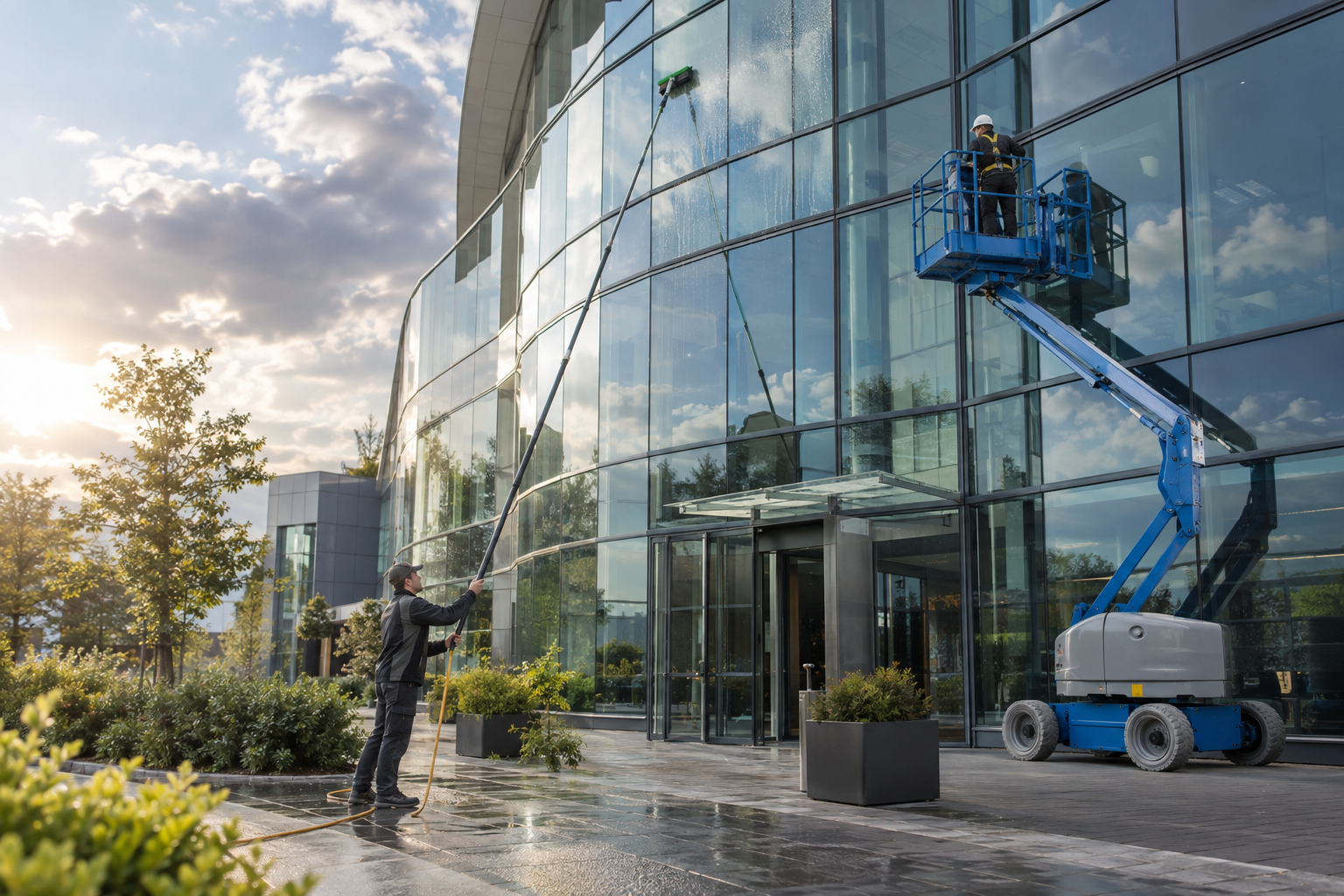

High-Rise Window Cleaning: Expert Methods
Table of Contents
-
Selection Steps: Determine the method based on your building
-
Our Cleaning Services: A Comparison of Pure Water Lances and Aerial Work Platforms
A dirty glass facade is visible from the street. And a customer, tenant, or vacationer who arrives at a vacation rental with dull windows forms an opinion before even stepping through the door. The problem is that once you go beyond the first floor, window cleaning is no longer just a quick wipe-down on Saturday morning. You have to choose an access point, secure the area, and sometimes block off a parking space. In short, cleaning windows at height becomes a full-fledged project in its own right.
Key Takeaways
-
This article moves beyond the DIY guide to offer an expert’s perspective on B2B
-
He analyzes how height, architecture, and safety dictate the use of a water boom, a aerial work platform, or a ladder, without imposing a single method
-
Determine the method based on your building
-
Compare the options and take action.
There are plenty of guides out there explaining how to make a makeshift pole or attach a sponge to the end of a broomstick. That’s not what we’re talking about here. Here, we’re talking about commercial buildings, condominiums, and accommodations with glass roofs or floor-to-ceiling windows 8 meters above the ground. The decision on how to clean windows at great heights depends on three factors: the architecture, the working height, and the safety of the workers. It doesn’t depend on which method you prefer.
At KHOMCLEAN, we don’t sell just one method. We assess the building and then decide whether to use a pure-water pole, an aerial lift, or—in very specific cases—a ladder. Here’s how we think about it, and why.
Selection Steps: Determine the method based on your building
Three meters, eight meters, twenty meters. These numbers make all the difference. A three-meter-high window can be cleaned from the ground using an extended hand tool. At eight meters, you’re already in the realm of the telescopic pole. Beyond twenty meters, the pole becomes unstable and the quality of the work suffers: this is the territory of the aerial work platform or the rope access technician. So the first step is to measure the working height actual height, that is, the distance between the ground where the operator is standing and the top of the last pane of glass. Not the height of the building, but the height of the glass to be reached.
The second criterion—and one that is often overlooked—is the available space. A 15-meter boom requires floor space to be maneuvered. If the building’s facade faces a narrow sidewalk, a hedge, a full parking lot, or a 4-meter-wide courtyard, the operator will not be able to work at the correct angle. The result: streaks, poorly rinsed corners, and a brush that doesn’t scrub effectively. The same logic applies to a cherry picker, which requires solid ground and a stabilization area for its outriggers. If the ground is waterlogged or the paving is fragile, a different solution is needed.
Third point, the’complex architecture. A flat glass facade is the easy case. But a building with roof overhangs, continuous balconies, sunshades, a high-up veranda attached to a gable, or a sloped glass roof—these obstruct direct access. Cleaning an inaccessible window isn’t a matter of simply trying hard enough. A skylight in the roof surrounded by tiles, for example, is cleaned using an angled pole from the ground if the slope allows it; otherwise, from an articulating boom lift that goes over the obstacle. Cleaning high-up skylights is, in fact, one of the situations where we see the most dangerous improvisations.
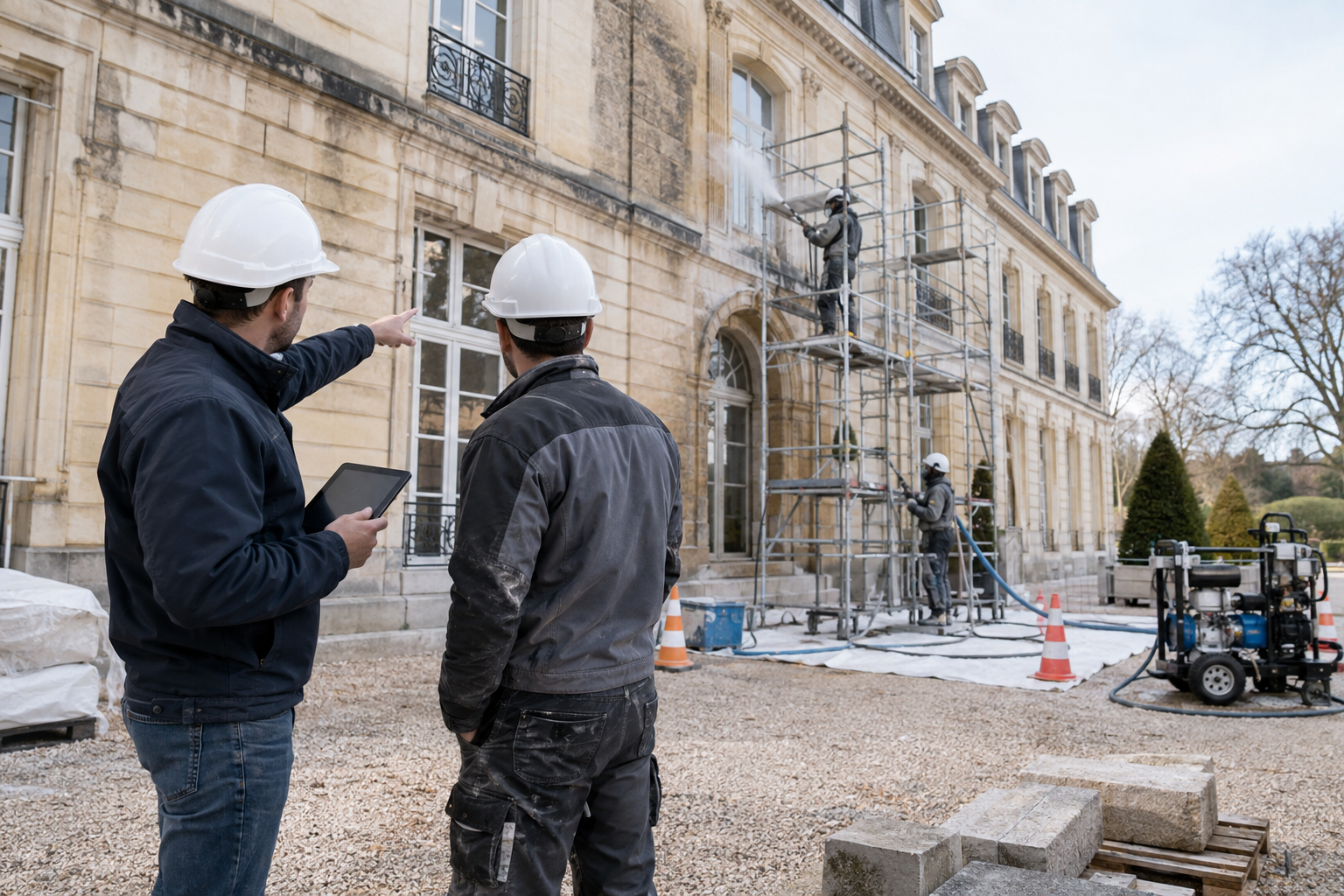
Here is the order in which we proceed during a technical inspection:
-
Elevation measurements by facade, pane by pane if the levels vary.
-
Analysis of the surrounding area: soil type, width, parking, pedestrian traffic, power lines.
-
Identification of architectural barriers and hard-to-reach windows (recessed corners, skylights, glass railings).
-
Select the primary method, then a secondary method for the remaining areas.
-
Draft the prevention plan if the site is occupied.
This last point is not just a formality. Working at heights remains the leading cause of serious accidents in the cleaning industry. A prevention plan formalizes who does what, when, and with what collective protective measures. In an occupied office building, this also means coordinating schedules so that a aerial work platform isn’t operating at the same time employees are heading out for lunch.
One final note on ladders, since we’ve been asked about them. The regulations allow their use for short-distance access and brief tasks, but not as a workstation. Washing ten windows on the second floor from a ladder is beyond the scope of these regulations. We use it only to reach an isolated window on an occasional basis, with a second worker on the ground, and we put it away immediately afterward.
Our Cleaning Services: A Comparison of Pure Water Lances and Aerial Work Platforms
What's the best tool for cleaning high windows? Honest answer: it depends on what we measured in the previous step. But there are two main categories, and they hardly overlap at all.
The telescopic pole for pure water First, the basic principle: a carbon-fiber pole (lightweight, rigid, and insulating), a brush at the top, and demineralized water flowing continuously through a hose. This water has been filtered via reverse osmosis and then through deionizing resin, reducing the residue level to near zero. Why is this important? Because water with 0 ppm leaves no trace when it dries. You brush to loosen the dirt, rinse, and let it dry without using a squeegee. The pure water system allows for the treatment of facades up to about 20 meters while keeping one’s feet on the ground, which resolves much of the issue of safety when working at heights: no suspended operator, no machinery.
The benefits are clear. No chemicals, so no residue on building facades or in flower beds. Quick setup—all you need is a fully equipped van. No need to block off parking spaces. And on windows exposed to urban pollution or limescale, the results last longer because no detergent residue attracts dust. It is currently the most effective method for cleaning high-rise windows on standard facades ranging from four stories to six stories high.
Now, its limitations—because it does have them. Beyond a certain length, the pole bends, and the operator loses the sense of contact. Windows that are very dirty (from construction, bird droppings, silicone residue) require an initial manual cleaning that the brush alone cannot handle. And if there isn’t enough clearance, you’re back to square one.
The aerial work platform Next. Scissor lifts for flat facades with hard surfaces, articulated when it’s necessary to go around a balcony or pass over a awning, and mounted on a truck when road conditions require it. The operator climbs up with standard equipment (a wetting tool, a squeegee, and a jug of pure water) and works directly against the glass. This is the solution for windows inaccessible to a pole: those over 20 meters high, skylights, atriums, and facades with significant overhangs. It’s also the method of choice for cleaning a high-up picture window behind a guardrail or for cleaning a high-up sunroom with a slope that prevents water from draining.
On the downside: logistics. You need a driver with a CACES certification, ground markings, often a permit to use public property if the machine extends into the street, and periodic inspections to ensure the machine is in compliance. Cleaning at height using a boom lift therefore requires more personnel and more preparation time.
What about those robots or magnetic window cleaners you see going by? They’re useful on a residential picture window on the first floor with a standard frame. On double-skin office windows, aluminum frames with protruding profiles, or sloped glass roofs, they lose their grip, leave streaks, and don’t clean the edges. They aren’t suitable for professional window cleaning.
At a single site, both methods are often used together: a boom lift for 80 % of the surface area, and a basket lift for complex window areas. It’s this combination that makes the difference between a clean job and a job that’s clean everywhere.
Where to Get Service and a Quote for Your High Windows
A property manager called us a few months ago regarding a three-story office building with a glass entrance canopy and a blind gable on the side facing the neighboring property. His initial request was just one line: «A quote for cleaning all the exterior windows.» It was impossible to provide a serious estimate without visiting the site. We went there, took measurements, and found that the glass canopy was accessible only by articulating boom lift from the parking lot, and that two windows on the gable side could be cleaned only with a pole from the neighboring lot—with the owner’s written consent. It’s these details that determine whether a quote holds up or falls apart during the project.
That's why a custom quote For high-rise window cleaning, a site visit is required. It’s not just an online form where you enter the number of windows. During this visit, we assess the surfaces, access points, occupancy constraints, and safety considerations. You will then receive a proposal specifying the method selected for each area, the duration of the work, the personnel and equipment required, and the recommended frequency. For windows in urban environments, a quarterly cleaning schedule maintains a good standard; in coastal areas or near major roads, we often increase the frequency due to salt spray and airborne particles.
Our B2B cleaning service is aimed at property managers, facility managers, hotel and bed-and-breakfast operators, retail businesses with tall storefronts, and local governments. What do these clients have in common? They want a service that doesn’t create extra work for them. Specifically, KHOMCLEAN handles the road permit application when the aerial work platform requires it, notifies occupants, manages the work zone signage, and provides a service report with before-and-after photos. For a vacation rental owner who lives 200 kilometers away, that’s what matters.
A word about the workers, since this question comes up regularly—including the issue of their pay. A technician qualified to work at heights, who holds a CACES certification for aerial work platforms and has been trained in the use of a safety harness, is paid more than a typical janitor on the pay scale. This is to be expected: they are responsible for their own safety and that of passersby. A service for cleaning inaccessible windows advertised at the same price as a simple window wash usually involves either uncertified equipment or an access method that should not be used. That’s not a risk worth taking on a building open to the public.
To submit a request, simply send us the building’s address, a few photos of the relevant facades, and your available time slots for the site visit. We’ll get back to you with a visit date, followed by a written proposal. If you manage multiple sites, we’ll create an annual schedule that groups maintenance tasks by area, which simplifies your oversight and eliminates the need to transport equipment back and forth.
Conclusion
Remember one thing: the right method for cleaning high windows is the one that’s tailored to your building, not the one the service provider has in their truck. Working height, ground clearance, architectural obstacles, and site occupancy dictate whether to use a pure-water pole or an aerial lift. A ladder remains a supplementary tool—never a workstation.
Do you have windows that haven’t been cleaned in months because «they’re too high» or «it’s too complicated»? Contact KHOMCLEAN to schedule a site visit. We’ll assess the situation, provide a proposal, and restore your facades to a spotless condition without you having to handle a single detail of the project.
Frequently Asked Questions
At what height does the pure water pole no longer suffice?
Up to about 20 meters, the carbon-fiber telescopic pole allows you to work on a facade while keeping your feet on the ground. Beyond that, the pole bends, the operator loses the sense of contact with the glass, and the quality of the work suffers: at which point one must switch to an aerial work platform or a rope access technician. The measurement point is not the height of the building, but the distance between the ground where the operator is standing and the top of the last pane of glass.
Why doesn't pure water leave any streaks on windows?
The water is demineralized through reverse osmosis and then through a deionizing resin, reducing the residue level to near 0 ppm. Free of minerals and detergents, it dries without leaving marks, allowing you to scrub, rinse, and let it dry without a squeegee. Another advantage: no chemical runoff onto facades or into flower beds, and the glass stays clean longer because no residue attracts dust.
In what situations is a basket more appropriate than a boom?
The aerial work platform takes over as soon as the boom can no longer operate properly: windows higher than 20 meters, skylights, atriums, facades with significant overhangs, picture windows behind a guardrail, or sloped sunrooms. However, it requires a load-bearing surface, an operator certified under the CACES program, proper signage, and often a permit to use public property. On a single job site, the telescopic boom is frequently used for the majority of the area, while the aerial work platform is used for complex areas.
Can you wash second-floor windows from a ladder?
Not as a workstation. Regulations permit the use of a ladder only for short-distance access and brief tasks; cleaning ten windows on the second floor from a ladder is not allowed. It is used solely to reach an isolated window on an ad hoc basis, with a second worker on the ground, and is then put away immediately. Working at heights remains the leading cause of serious accidents in the cleaning industry.
Why is a site visit required to get a quote for tall windows?
Because the price depends on factors that an online form cannot capture: actual height by facade, available setback from the property line, nature of the terrain, architectural obstacles, parking spaces, and power lines. A three-story building may require an articulating boom lift for its skylight and an extension pole from the neighboring lot for two gable windows. The written proposal then specifies the method by zone, the duration, the resources required, and the recommended frequency—quarterly in urban areas, and more frequently in coastal areas or near major roads.
Should you be wary of a very low price for cleaning hard-to-reach windows?
Yes. A technician certified to work at heights—who holds a CACES certification for aerial work platforms and is trained in the use of a safety harness—is paid more than a standard cleaning worker on the pay scale, because he is responsible for his own safety and that of passersby. A service advertised at the same rate as a simple window cleaning usually hides uninspected equipment or an access method that should not be used—a risky gamble on a building open to the public.

 Français de Belgique
 English
 Nederlands (België)
0 Comments