



Window Cleaning in Nursing Homes: Expertise in the Service of Seniors
Table of Contents
-
Techniques and Equipment: From Aerial Work Platforms to On-Site Expertise
-
A Human-Centered Approach: Respecting Residents’ Living Space and Privacy
-
Hygiene and Transparency: The Benefits of a Professional B2B Service
A dirty picture window in a nursing home isn’t just an aesthetic issue. It means less light for residents who sometimes spend 20 hours a day indoors. And when you consider that light directly influences the circadian rhythm, mood, and even sleep quality in older adults, the issue takes on a whole new significance. We’re no longer talking about cosmetic maintenance—we’re talking about quality of life.
Our Expertise
-
KHOMCLEAN goes beyond simple technical cleaning by incorporating an essential human dimension: respect for the nursing home as a true living space
-
We combine the use of specialized equipment (aerial work platforms, ladders, telescopic poles, pure osmosis water) with rigorous training for our staff in empathy and discretion, thereby ensuring a bright and serene environment without disrupting the daily lives and privacy of our senior residents
-
From the gondola to on-site expertise
-
respect residents' living space and privacy
Except that cleaning windows in a nursing home is a unique challenge. There’s the technical side: working at heights, sunrooms, tilt-and-turn windows locked in the safety position, and railings that block access. And then there’s everything else. Rooms where people are sleeping. Disoriented residents who might become anxious at the sight of a stranger at the window. Hallways where wheelchairs and medical carts are constantly moving. A professional window cleaner who shows up just like they would at an office building is bound to cause a mess.
At KHOMCLEAN, we’ve built our approach to window cleaning in nursing homes around this two-pronged requirement. On the one hand, we focus on the equipment and technical expertise; on the other, we train our staff to respect the residents’ living space. Because a nursing home isn’t just another commercial building—it’s home to its residents.
Techniques and Equipment: From Aerial Work Platforms to On-Site Expertise
Let’s start with the practical details. In a medical-social facility, windows generally fall into three categories based on difficulty. Windows accessible from the inside, those requiring a telescopic pole, and those that can only be reached using mechanized access equipment. The distribution varies depending on the building’s architecture, but an 80-bed facility spread over three floors with a dining veranda easily includes all three types.
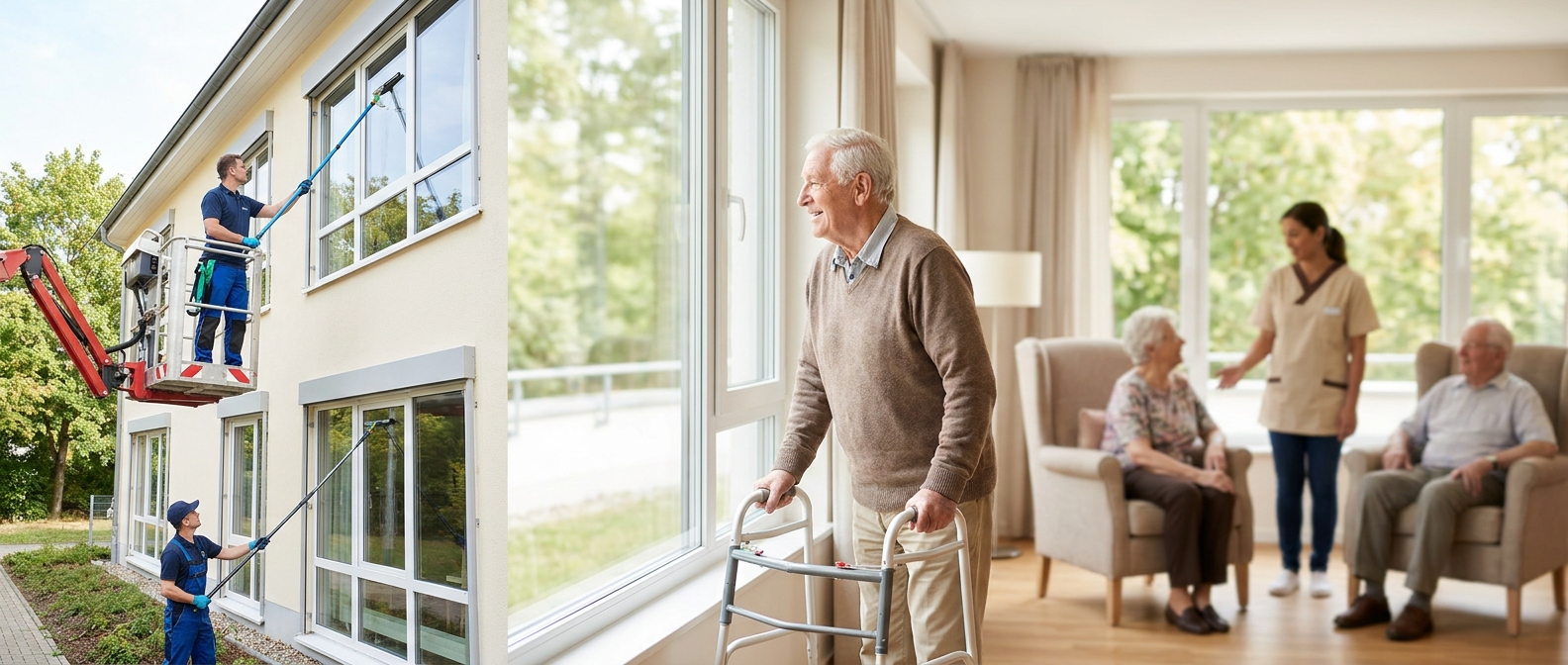
Working at heights is where the difference between a professional service provider and a risky DIY job really comes into play. The use of an aerial work platform is subject to a specific regulatory framework: an operator’s license issued by the employer, VCA training for our operators, and proper marking of the work area. And in a schoolyard where ambulances and families are coming and going, marking off the work area takes on a very practical significance.
For medium heights, we consistently prefer to use a carbon-fiber pole with reverse-osmosis water rather than a ladder. There are two reasons for this. First, the safety of our staff: ladders remain the leading cause of workplace accidents in our industry. Second, efficiency: demineralized water dries without leaving a trace, so there’s no need for a squeegee, no finishing touches, and no need to go back over the window. We can clean surfaces up to 12 meters high from the ground, without scaffolding and without blocking a walkway. How do you clean inaccessible exterior windows? Here’s the technical solution, and it’s better than any makeshift hack.
Professional-grade equipment isn’t just about large machinery. It also includes microfiber cloths designed for lacquered aluminum window and door frames, rubber squeegees that are replaced regularly, scrapers for removing paint residue after a job, and cleaning agents compatible with EPDM seals. A product that’s too harsh can damage the seals in just three applications, leaving you with leaks. This happens more often than you’d think.
One final technical point that is often overlooked: the preliminary assessment. Before any work begins, our team leaders walk through the building with the maintenance manager. We note any stuck windows, cracked glass, damaged exterior blinds, and areas where the floor cannot support the weight of a cherry picker. This prevents unpleasant surprises and ensures an accurate estimate. Be wary of any quote based solely on blueprints without an on-site visit.
A Human-Centered Approach: Respecting Residents’ Living Space and Privacy
A nursing home director told us the following story: A former service provider had sent two window cleaners who, perched in their aerial lift, appeared in front of a resident’s window just as a nursing assistant was changing her. No one had given any advance notice. The family filed a complaint. This kind of incident isn’t an accident—it’s a failure to follow protocol.
Respecting privacy in healthcare facilities requires simple but non-negotiable rules. We never work in front of a patient’s room without the care team having been informed of the time slot. Knock. Wait. If a curtain is drawn, move on and come back later. Our staff members know that a closed room is not an obstacle to be bypassed but a boundary to be respected. This rule is more important than the schedule.
Our trained staff undergoes a specific training module before being assigned to a nursing home. The training also covers proper conduct: speaking softly, facing the person, not approaching from behind, and never touching a wheelchair without asking first. These are basic practices in the healthcare sector, but they do not come naturally to a cleaning professional. They must be taught.
Discretion is also a matter of logistics. Our activities are scheduled around the facility’s daily routine, not the other way around. We use the common areas early in the morning, before the residents come downstairs. We work in the rooms during activities in the recreation room or during meals. Never during nap time, never during weekend visits. The residents’ well-being depends on the absence of disruption, and this is coordinated with the healthcare coordinator during the planning meeting.
Our staff members wear identifiable uniforms and visible name tags, and always check in at the front desk. In a facility where the safety of vulnerable individuals is a daily concern, knowing who is in the hallways is not optional. Residents’ comfort begins with the care team’s trust in outside visitors.
Hygiene and Transparency: The Benefits of a Professional B2B Service
A question that comes up regularly: Is a housekeeper allowed to clean windows? Yes, for windows that are accessible from the ground, indoors, and without a risk of falling. No, as soon as it involves climbing onto a platform, leaning over a drop, or working on the exterior of a building. The Labor Code is clear regarding work at heights, and the employer is held liable. Many establishments still assign window cleaning to their in-house maintenance staff out of habit or to save money. This poses a real legal risk and rarely yields good results on large surfaces.
Health and social care hygiene standards extend beyond floors and restrooms. Interior windows, glass doors, and transparent partitions in high-traffic areas are all contact surfaces. Door handles, door frames, and handrail areas at wheelchair height are all points that are touched dozens of times a day. Our protocols include disinfecting these areas with virucidal products compliant with EN 14476 standards, using single-use wipes or color-coded wipes depending on the area. During an epidemic, these are the kinds of details that make a difference.
In practical terms, regular maintenance is less expensive than catch-up cleaning. A window cleaned four times a year requires only a quick wipe-down. The same window, if left uncleaned for two years, accumulates limescale, pollution, and organic residues, and requires a more intensive treatment (demineralizing, and sometimes polishing). We recommend cleaning exterior surfaces quarterly and interior windows in common areas monthly. For establishments located along a road or near a railroad track, we increase the frequency.
Optimal glass clarity has a measurable effect on the atmosphere. A well-lit lobby appears larger and more welcoming, and that matters when a family visits the facility for the first time. Your windows are the first thing people see, even before they walk through the door. One director told us that feedback from pre-admission visits had improved after they resumed maintenance of the glass facades. Anecdotal? Perhaps. Consistent? Certainly.
Transparency also applies in a contractual sense. Every KHOMCLEAN service is governed by detailed specifications: surfaces to be cleaned, frequency, access methods, time slots, and a dedicated point of contact. Our service reports are provided after each visit, noting any issues observed (cracked glass, damaged seals, jammed blinds). This provides you with traceability for your quality records and useful information for your maintenance plan. Service safety is fully documented: training certificates, equipment inspection certificates, and professional liability insurance—all are available upon request.
Conclusion
Window cleaning in nursing homes requires two skills that are rarely found together: proficiency in working at heights using a cherry picker and professional equipment, and a deep understanding of what a living space for the elderly is like. A service provider who meets only one of these two criteria will cause you problems sooner or later.
Do you manage a nursing home and have questions about your current operations? Try this: ask your care team what they think about outside service providers. Their answers are often insightful. And if you’d like a FREE assessment of your glass surfaces with a precise cost estimate, contact KHOMCLEAN. We’ll come take a look, measure the space, and propose a cleaning plan tailored to your building and your residents’ needs. No obligation, and no jargon.
Frequently Asked Questions
Why is window cleaning so important in a nursing home?
Because residents sometimes spend twenty hours a day indoors: a dirty window means less light. Yet light affects older adults’ circadian rhythms, mood, and sleep quality. So we’re moving beyond mere cosmetic maintenance to focus on the comfort of daily life.
Can the in-house cleaning staff wash the windows at the facility?
Yes, for windows that are accessible from the ground, indoors, with no risk of falling. However, if you need to climb onto a platform, lean over an open space, or work on the building’s exterior, the answer is no: regulations governing work at heights apply, and the employer is held liable. Entrusting facade work to an in-house team remains a real legal risk.
How does KHOMCLEAN protect residents' privacy during the procedure?
No work should be done outside a patient’s room without the care team having been informed of the time slot. Staff members knock, wait, and if a curtain is drawn, they move on and return later. A closed room is not an obstacle to be bypassed but a boundary to be respected; this rule takes precedence over the schedule.
How often should the windows in a nursing home be cleaned?
The recommended frequency is quarterly for exterior windows and monthly for interior windows in common areas, with more frequent cleaning required for facilities located along a road or near a railroad track. Regular maintenance is less expensive than remedial work: if the glass hasn’t been treated for two years, it will require extensive treatment, such as demineralization or even polishing.
What equipment is used for inaccessible exterior windows?
For intermediate heights, the carbon-fiber pole with reverse-osmosis water is the preferred method: cleaning can be done from the ground up to twelve meters, without scaffolding or blocking traffic, and the demineralized water dries without leaving a trace. For heights above that, an aerial work platform is used, requiring a CACES R486 certification, an operator’s license, periodic inspection of the equipment, and proper marking of the work area.

 Français de Belgique
 English
 Nederlands (België)
0 Comments