



Solar Panel Cleaning: The KHOMCLEAN Expert Guide
Table of Contents
-
Professional Cleaning Methods: Pure Osmosis Water in Belgium
-
Critical Mistakes to Avoid and the Benefits of Regular Maintenance
A solar power system is a financial asset, not just a gadget mounted on a roof. And like any asset, it generates a return that can be measured, compared, and—above all—lost. Most Belgian homeowners discover this when they look at their production curve on the inverter’s app: three years after installation, the summer peaks are no longer the same as they were in the first season. The equipment hasn’t aged a bit. It’s simply dirty.
Key Takeaways
-
KHOMCLEAN brings professional expertise to the Belgian market, with a focus on the financial impact of lost productivity
-
We contrast risky DIY methods with the effectiveness of pure osmosis water and telescopic equipment to ensure the longevity of solar assets
-
The Impact of Dirt on the Performance of Your Solar Panels
-
Pure osmosis water in Belgium
At KHOMCLEAN, we service everything from residential roofs to industrial facilities with 2,000 m² of solar panels. The conclusion is always the same: between a well-maintained system and one left exposed to the rain, there is a difference in energy production amounting to hundreds of euros per year. Cleaning solar panels is not just a cosmetic procedure; it is solar maintenance in the strictest sense.
This guide provides the information we typically explain to our customers in person: what dirt actually costs, why pure osmosis water has replaced the bucket and sponge, what mistakes can destroy a module in a single service visit, and how much professional maintenance costs in Belgium. We don’t beat around the bush when it comes to what constitutes risky DIY.
The Impact of Dirt on the Performance of Your Solar Panels
Between 10 and 30 %. This is the range of efficiency loss measured in the field, depending on the environment and how long it has been since the last cleaning. It’s a wide range, yes, because it all depends on what accumulates on the glass. A roof in the Brabant countryside near a farm is nothing like an office building along the Brussels ring road.
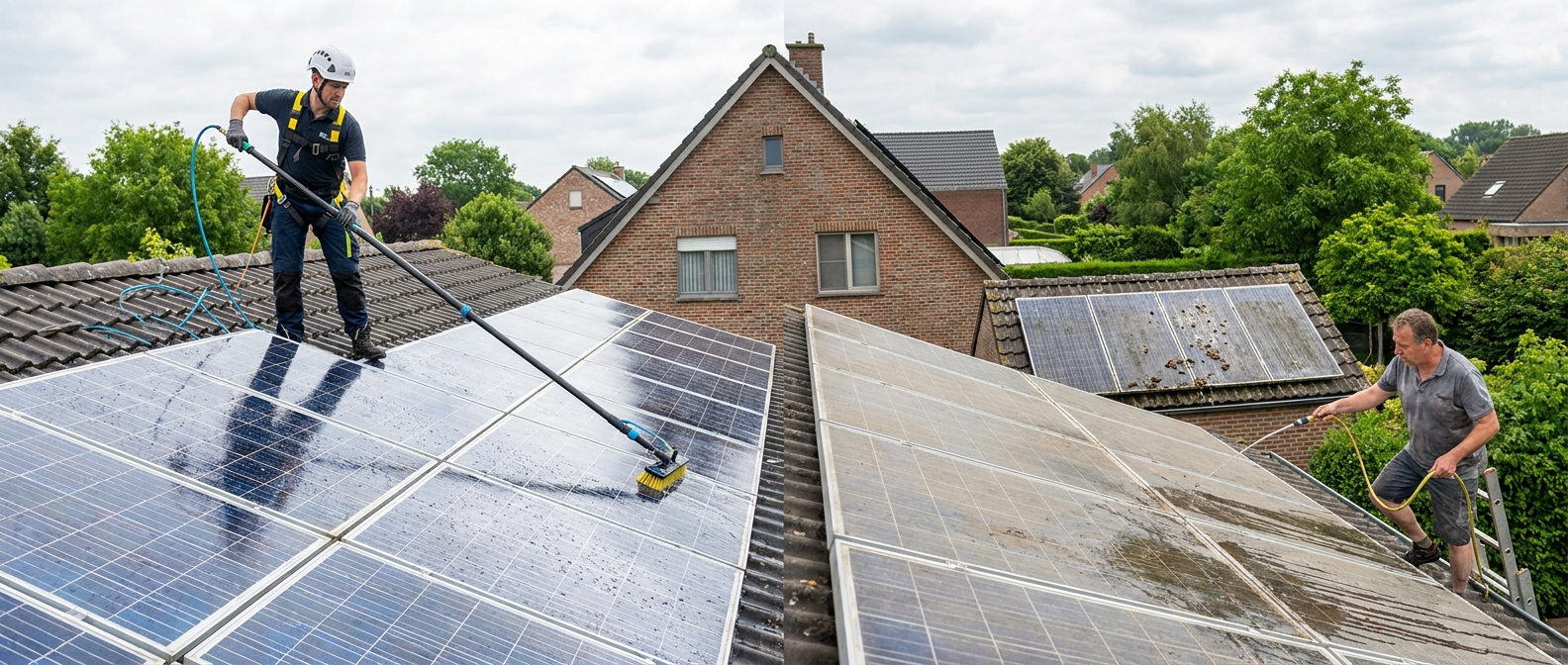
The mechanism is simple. A photovoltaic cell needs photons. Anything that comes between the sun and the silicon reduces output. Dust buildup creates a uniform film that causes photovoltaic efficiency to drop by a few percent—quietly, without anyone noticing. This is the most insidious loss of productivity: it’s gradual, and therefore invisible.
Bird droppings, on the other hand, are in a league of their own. A drop of bird droppings is opaque and localized. It completely blocks the light from one or more cells. However, the cells in a module are wired in series: the weakest cell dictates the output of the entire string. This phenomenon of hot spot (hot spot) causes the local temperature to rise, degrades the EVA encapsulant, and eventually causes permanent damage to the cell. If bird droppings are left on a module for two summers, that module cannot be fully restored.
Add air pollution to the mix. In Belgium, fine particulate matter from traffic and heating combines with humidity to form a greasy film. Contrary to what many people think, this layer isn’t washed away by rain. It clings to surfaces, traps more dust, and the cycle accelerates. In the industrial areas of Wallonia and in the Port of Antwerp, there are also deposits of soot and particularly stubborn oily residues.
There’s another factor that’s often overlooked: the moss and lichens on the edges of the frames. Rainwater flows down by gravity and pools at the bottom of the module, on the lip of the aluminum frame. Plants take root there, growing one to two centimeters up the glass and obscuring the bottom row of cells. Once again: series wiring, a cascading effect across the entire panel.
In practical terms, for a 6 kWp residential system producing 5,500 kWh per year, a loss of 15 % amounts to approximately 825 kWh. Depending on the value of your self-consumption and the current electricity rate, we’re easily talking about 200 to 250 € going down the drain each year. For a 300 kWp logistics facility, the same loss amounts to tens of thousands of euros. Maintaining solar panels isn’t about aesthetics—it’s about the meter.
Professional Cleaning Methods: Pure Osmosis Water in Belgium
Let's ask the question straight out: What product should you use to clean solar panels? Here's the professional answer—and it always comes as a surprise: none. No detergent, no castile soap, no vinegar. Just water. But not just any water.
The’pure osmosis water is water that has passed through a reverse osmosis system, which removes dissolved minerals, limescale, nitrates, and impurities. The TDS level drops below 10 ppm, often reaching 0 ppm with post-treatment using deionizing resin. This water has a remarkable property: it is «hungry.» Chemically unstable, it seeks to replenish itself with minerals and therefore captures dirt through simple contact. It cleans without chemicals, then evaporates, leaving absolutely nothing behind. No streaks, no water spots, and no residual film that would become a dust trap the following week.
Compare this with tap water. In Belgium, water hardness varies by region between 15 and 40 °f, with high levels in Hainaut, Walloon Brabant, and much of Flanders. Cleaning with tap water deposits limescale on the glass. As they dry, the droplets leave mineral rings that scatter light and reduce light transmission. You’ve washed the panel and degraded its performance. It’s counterproductive.
The second pillar is the telescopic pole. Our teams use carbon-fiber poles ranging from 12 to 20 meters in length, supplied with pure water through a built-in hose and fitted with a brush featuring soft, non-abrasive bristles specifically designed for tempered glass. The result: the operator remains on the ground; no one walks on the roof, and no one steps on a panel. This is because stepping on a panel—even just once—creates invisible microcracks in the cells that will result in irreversible production losses a few months later.
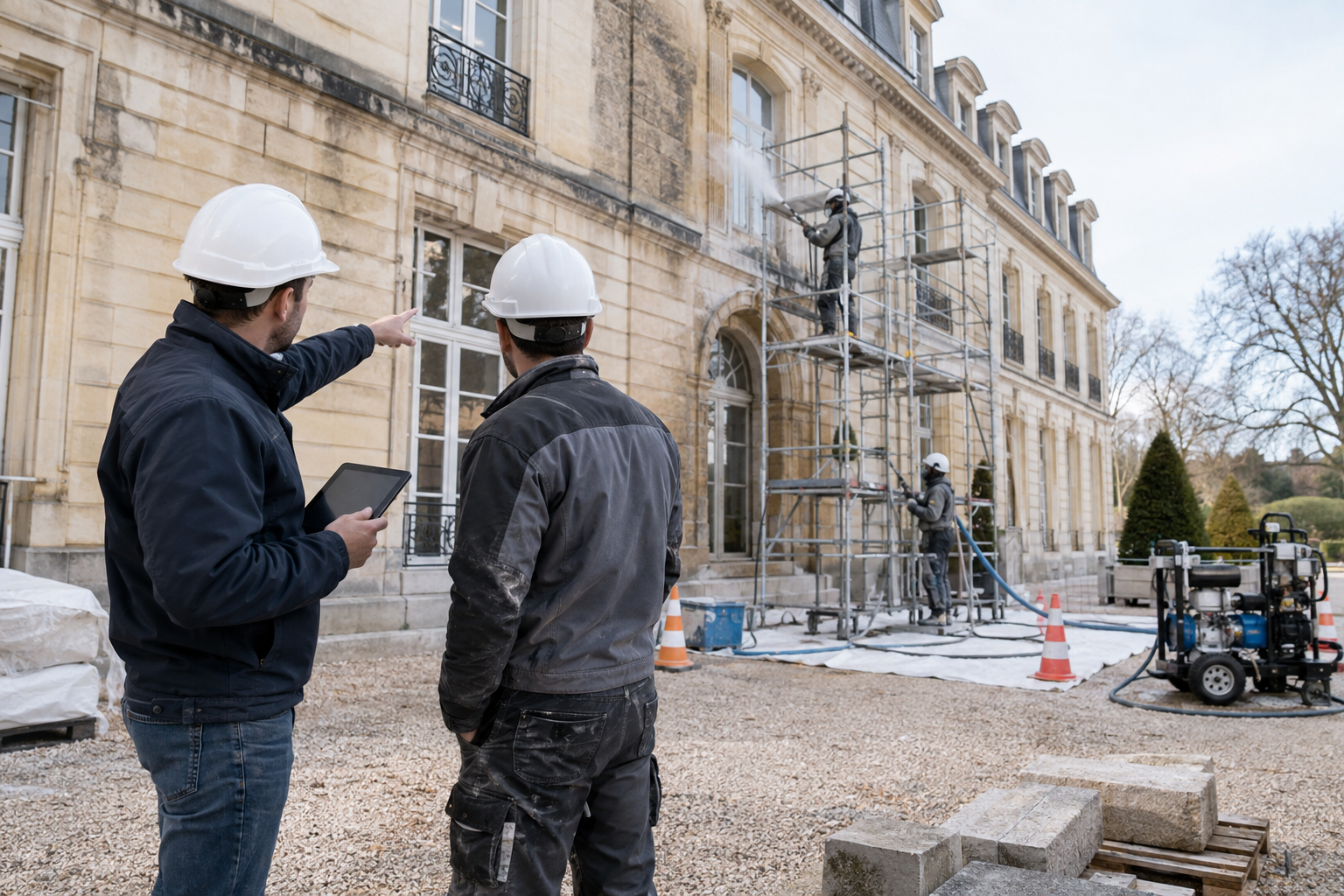
On large industrial roofs and ground-mounted power plants, we supplement our work with rotating brushes fed with reverse-osmosis water and, when the configuration requires it, aerial work platforms or lifeline systems. The choice of method depends on the slope, accessibility, and type of mounting.
Regarding cleaning frequency: the Belgian climate works in our favor to some extent. It rains often, which limits the buildup of dry grime. But our climate is also humid, mild, and conducive to moss, algae, and pollen. Our recommendation: one procedure per year For a standard residential roof, ideally in the spring after the pollen season and before the months of heavy pollen production. Two cleanings per year if you’re near trees, a farm, a busy road, or an industrial area. For low-slope roofs (less than 15°), it’s also twice a year, no question about it: the water doesn’t run off fast enough to flush anything away.
As for solar panel cleaning rates, prices in Belgium generally range from €4 to €8 (excluding tax) per module for residential systems, plus a flat-rate travel fee. A system with 20 panels therefore typically costs between €150 and €250. For industrial photovoltaic systems, pricing is based on square meters or kWp, with sliding-scale rates. The cost of maintaining photovoltaic panels is almost always less than the increase in power generation realized in the first year.
Critical Mistakes to Avoid and the Benefits of Regular Maintenance
We regularly get calls about systems that have already been damaged by attempts at DIY cleaning. So here’s the “blacklist”—the one that’s going to cost you.
The pressure washer comes out on top. A Kärcher delivers between 100 and 150 bars of pressure. Tempered glass can withstand it, sure. But the seals between the frame and the glass can’t. Neither can the junction boxes on the back. Pressurized water seeps in, reaches the connections, and causes corrosion and insulation failures. Add a thermal shock if you spray cold water onto a module heated to 60 °C in direct sunlight: the glass can crack cleanly. And to top it all off, high pressure voids the warranty of virtually all manufacturers.
The abrasive products and then household cleaning products. Scouring pads, scouring powder, dish soap, window cleaner—all of these can scratch the glass or leave a film. Micro-scratches on the glass scatter light instead of transmitting it, and they’re permanent. As for cleaning products, they damage the anti-reflective coating found on most recent modules. This coating alone accounts for several percent of the panel’s efficiency. Once it’s gone, it doesn’t come back.
This raises the question of the safety, and I’m not going to beat around the bush here. How do you clean solar panels yourself? From the ground, using a pole—or not at all. Falls from heights remain the leading cause of serious accidents in the construction industry. A wet roof covered in soap, 6 meters above the ground, with slippery tiles: that’s a recipe for an accident. Our technicians are trained in working at heights, properly equipped, and covered by professional liability insurance. This isn’t a sales pitch—it’s the difference between a construction site and a news story.
Two more details that enthusiasts may not know. Never clean a panel when it’s extremely hot or at midday: do it early in the morning or late in the day, when the modules are cool. And never scrape off dried bird droppings while they’re still dry: soften them with plain water, wait a bit, then brush them off with a soft brush.
Let’s move on to the benefits, because that’s where the math becomes clear. Regular maintenance restores between 5 and 20 % of production, depending on the initial condition. It preserves the system’s longevity by eliminating the causes of hot spots, which are the main factor in premature cell degradation. It protects your warranties, since most manufacturers require proper maintenance to honor a 25-year performance warranty. It also maintains the building’s resale value: a buyer who sees an up-to-date maintenance log won’t negotiate the same way.
And there’s a less obvious benefit: our technicians perform visual inspections during the service call. A warped frame, a seal coming loose, a dangling cable, burn marks on an enclosure, a loose fastener. We report them. Detecting a defect before it turns into a failure—that’s where solar maintenance really comes into its own.
Conclusion
Cleaning solar panels is about maximizing efficiency, not aesthetics. Pure osmosis water, a telescopic pole, an annual cleaning routine tailored to the Belgian climate, and no improvising on the roof: this is the protocol that protects both your energy production and your equipment. Everything else—high-pressure washers, household cleaners, wobbly ladders—poses unnecessary risks.
KHOMCLEAN serves clients throughout Belgium, from residential roofs to large industrial facilities, using specialized equipment and teams trained in working at heights. Want to know how much dirt is costing you and what a cleaning job would entail for your setup? Contact us for an audit and a detailed quote. We’ll also tell you, honestly, if your panels don’t need cleaning this year.
Frequently Asked Questions
How much power output is actually lost when solar panels are dirty?
Field measurements indicate that the loss ranges from 3 to 30 %, depending on the environment and how long it has been since the last cleaning. For a 6 kWp residential system producing 5,500 kWh per year, a loss of 15 % is equivalent to approximately 825 kWh—which easily amounts to 200 to 250 € wasted each year. For a 300 kWp logistics facility, the cost runs into the tens of thousands of euros.
What product should be used to clean solar panels?
No detergents, no black soap, no vinegar: just pure osmosis water, stripped of minerals through reverse osmosis and with a TDS level below 10 ppm. Chemically «deprived,» it captures dirt through simple contact and then evaporates without leaving the slightest trace or residual film that would otherwise become a dust trap.
Why not just wash the panels with tap water?
In Belgium, water hardness ranges from 15 to 40 °f, with high levels in Hainaut, Walloon Brabant, and much of Flanders. Washing with tap water is equivalent to depositing lime scale on the glass: as they dry, the droplets leave mineral rings that scatter light and reduce light transmission. The panel is clean but less efficient.
How often should you have your solar panels cleaned in Belgium?
One cleaning per year is sufficient for a standard residential roof, ideally in the spring after the pollen season and before the months of heavy pollen production. Increase this to two cleanings per year if you’re near trees, a farm, a busy road, or an industrial area. The same rule applies to low-slope roofs (less than 15°), where water doesn’t run off effectively.
How much should you budget for professional sign cleaning?
For residential systems, the cost ranges from 4 to 8 € (excluding tax) per module, plus a flat-rate travel fee: a 20-panel installation generally costs between 150 and 250 €. For industrial solar systems, billing is based on square meters or kWp, with sliding-scale rates. The cost is almost always lower than the savings from increased energy production realized as early as the first year.
Can I clean my panels myself with a Karcher?
Don’t do this under any circumstances: A high-pressure washer delivers 100 to 150 bars of pressure, which causes seals to fail and weakens junction boxes, leading to water infiltration, corrosion, and insulation failures. Spraying cold water onto a module at 60 °C can even crack the glass, and this practice voids the warranty of virtually all manufacturers.

 Français de Belgique
 English
 Nederlands (België)
0 Comments