



Escalator Cleaning: KHOMCLEAN’s Expertise for Your Facilities
Table of Contents
-
Our professional cleaning services for escalators and moving walkways
-
The Technical Protocol: Key Steps for Sustainable and Secure Maintenance
-
Pricing and Quotes: Why Choose KHOMCLEAN as Your Leading Partner in Belgium
An escalator carries between 5,000 and 20,000 people per day in a medium-sized Belgian shopping center. Each of these people leaves something behind on the steps: gravel, de-icing salt, chewing gum, drink spills, and fabric lint. Multiply that by 300 days of operation, and you end up with a compact layer that becomes embedded in the aluminum grooves. That’s when it becomes a technical problem, not just an aesthetic one.
Key Takeaways
-
We are transforming a little-known service into a strategic maintenance tool
-
As a Belgian leader, KHOMCLEAN educates facility managers on the visual and technical impact of cleaning steps and risers, ensuring the longevity of assets and a premium customer experience
-
also encourage installers to offer this service to their customers (for example: Otis offers an escalator cleaning service to its customers)
-
Compare the options and take action.
Most managers first become aware of the issue the day a maintenance technician reports premature wear on the chains or a damaged comb. By then, it’s too late. Escalator cleaning isn’t a cosmetic service you add when the budget allows—it’s a preventive maintenance task just like lubrication or brake inspections. The grooves in the steps are designed with a tolerance of a few millimeters relative to the comb. When they fill with compacted grime, friction increases, parts wear out, and breakdowns occur.
At KHOMCLEAN, we’ve built our service offering around this insight. We work with facility managers, retail property owners, and train station operators—and increasingly with escalator installers who want to enhance their maintenance contracts without investing in specialized equipment. Here’s how we work, what it costs, and why this service deserves its own line item in your maintenance budget.
Our professional cleaning services for escalators and moving walkways
Three formats, depending on your setup and traffic volume.
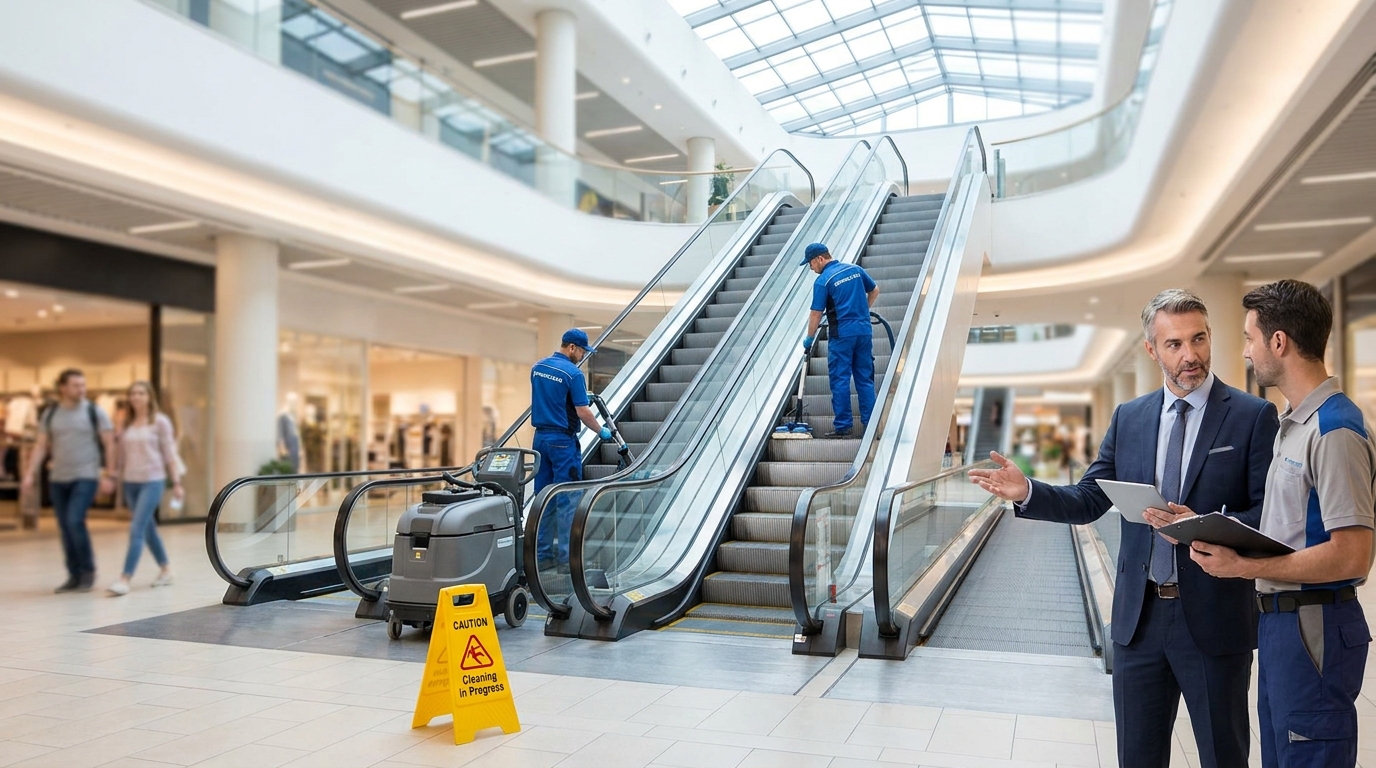
The refresher course. This is the starting point for 80 % of our new customers. An escalator that has never been thoroughly cleaned—or whose last cleaning was three years ago—requires intensive treatment: complete scrubbing of the grooves, degreasing of the risers, removal of embedded chewing gum, and cleaning of the side baseboards and handrails. The service typically takes 2 hours and 30 minutes per escalator. The result is spectacular—literally: the steps regain their original aluminum finish, and users immediately notice the increased brightness.
The recurring contract. Once the resurfacing is complete, maintaining the treads and risers is easy with scheduled visits. For a shopping center, we recommend two visits per year. For a train station or subway station, visits should be quarterly. For a two-story store with moderate foot traffic, two visits per year are sufficient. The logic is simple: the longer you wait between visits, the more expensive each service call becomes because it essentially turns into another resurfacing job.
Subcontracting for installers. Otis, Schindler, Kone, TK Elevator: all the major players offer comprehensive maintenance contracts, and many now include a cleaning component. However, deep cleaning requires specialized equipment, product expertise, and teams trained in specific safety protocols. We operate as a white-label provider for several companies in the sector in Belgium. They manage the customer relationship; we provide the technical expertise.
We also service travelators (inclined or flat moving walkways), which are almost always overlooked. A travelator in an underground parking garage accumulates tire residue, motor oil, and gravel. Its grooves are wider, dirt settles in them differently, and the cleaning protocol is not the same as that for a conventional escalator. A business’s cleanliness often hinges on these details: customers don’t notice a clean escalator, but they always notice a dirty one.
A word about handrails. How do you remove grime from an escalator handrail? Not with a cloth and all-purpose cleaner. The black rubber deeply absorbs oil and fingerprints; you need a specialized product that removes the grime without damaging the material, followed by a disinfectant treatment. It’s the most frequently touched part of the entire installation—and the most neglected.
The Technical Protocol: Key Steps for Sustainable and Secure Maintenance
Do you know the three basic rules of professional cleaning? From cleanest to dirtiest, from top to bottom, from dry to wet. They apply here as well, but with one additional constraint: we’re working on a moving electromechanical machine that’s partially locked out. That changes everything.
Step 1: Securing and Documenting. First and foremost, we cordon off the area. Barriers, bilingual signage, and coordination with the site’s technical department. The escalator is set to reduced-speed maintenance mode or operated manually, depending on the model. User safety takes precedence over the schedule: in 95 % of cases, we perform work at night or outside of operating hours.
Step 2: Dust removal and pretreatment. Vacuuming the grooves, removing foreign objects (coins, bottle caps, pebbles), and, above all, visual inspection. Our operators systematically report what they see: a warped step, a damaged baseboard joint, a cracked comb. This feedback is invaluable to your escalator maintenance team. We don’t repair—we alert.
Step 3: Machine processing. This is the core of the business. A professional escalator cleaner is a machine equipped with cylindrical brushes that conform to the geometry of the grooves, coupled with an injection-extraction system. The brushes rotate in the opposite direction of the moving steps, allowing them to tackle grime in both directions. The cleaning solution used must be aluminum-safe, non-foaming, and pH-controlled: a detergent that is too alkaline will irreversibly tarnish the metal. We perform multiple passes depending on the level of soiling, with a visual inspection between each cycle.
Step 4: Riser steps and perimeter. The risers—the vertical surfaces between each step—are most visible when climbing the stairs. They are machined, though the finishing touches are often done by hand or with a detail tool. The same applies to the side skirting, the yellow safety strips, and the combed areas at the entry and exit points.
Step 5: Drying and putting it back into service. No escalator is returned to service while it is still damp. The machine removes 99.9% of moisture. Then, a test run at normal speed, without passengers, is conducted before reopening.
This cleaning method yields measurable results: on equipment that is cleaned regularly, there is a clear reduction in corrective maintenance related to combs and chains. The link between cleanliness and mechanical longevity is by no means theoretical. An escalator costs between 80,000 and 200,000 euros. An annual cleaning contract represents a fraction of a percent of that asset’s value. Do the math.
Pricing and Quotes: Why Choose KHOMCLEAN as Your Leading Partner in Belgium
Straightforward question: How much does it cost? The price of an escalator cleaning depends on four factors: the height difference (i.e., the number of steps), the initial condition of the escalator, the accessibility of the site, and the number of escalators cleaned during the same service call.
The cost of recurring maintenance under a contract drops significantly because grime hasn’t built up again and the service time is cut in half. If you have eight units at the same location, the unit cost drops even further: travel, machine setup, and logistics are shared. It’s simple math, and that’s why we prioritize group service campaigns.
Our estimate is free and is calculated after a technical inspection. We don’t send flat-rate price lists via email without first seeing the installation—that’s meaningless. Two escalators of the same length can require anywhere from one to three times as much work, depending on their maintenance history. We come on-site, inspect, provide a quote, and commit to the job.
What sets us apart in the Belgian market comes down to three key points. First, our equipment: we invest in specialized machinery, not in general-purpose equipment that’s been adapted as best as possible. Second, our teams: our operators are specifically trained for this type of work, hold the necessary certifications, and are familiar with the lockout/tagout protocols of the major manufacturers. Finally, our nighttime availability: we operate night shifts year-round.
We serve Brussels, Flanders, and Wallonia, with regular assignments in Antwerp, Ghent, Liège, Charleroi, and Namur. However, part of our client portfolio is located throughout the Benelux region. Our teams travel anywhere.
To installers and maintenance companies reading this: Offering cleaning services to your existing customers is likely the easiest way to generate additional revenue within your current portfolio. You already have the relationship, the contract, and access to the site. All you’re missing is the technical expertise and the equipment. That’s exactly what we provide—on a white-label basis—with a commitment to complete discretion. Many of our Belgian partners have been operating this way for years.
One final point that matters more than you might think: traceability. Every service call is documented in a report that includes before-and-after photos, a list of any issues found, and approval from the site manager. You have a detailed record that you can use for your audits and budget decisions. As experts in B2B cleaning, we believe the job isn’t done until the client has written proof of what was done.
Conclusion
A dirty escalator sends an immediate message about the quality of a facility’s management. But beyond the image it projects, it’s an asset worth tens of thousands of euros that’s being allowed to wear out faster than necessary. When performed with the right equipment and following a rigorous protocol, escalator maintenance extends the service life of mechanical parts and reduces unplanned downtime.
Do you manage a shopping center, a train station, a department store, or a property portfolio with escalators? Contact KHOMCLEAN for a technical inspection and a free estimate. We travel throughout Belgium, provide precise cost estimates, and perform our work while your patrons are asleep. If you’re an installer or maintenance provider, let’s discuss a partnership: we’re used to working behind the scenes for our clients.
Frequently Asked Questions
Why is cleaning an escalator considered maintenance and not just a matter of aesthetics?
The grooves in the steps have only a few millimeters of clearance relative to the comb. When they become clogged with compacted dirt, friction increases, parts wear out, and breakdowns occur. Thorough cleaning, therefore, serves the same purpose as lubrication or brake inspection: it extends the life of the chains and racks and reduces unplanned downtime.
How often should you have your escalators cleaned?
It all depends on foot traffic: two to three inspections per year for a shopping center, once every quarter for a train station or subway station, and two inspections per year for a two-story store with moderate foot traffic. The longer the intervals between inspections, the more each inspection becomes a major overhaul—and therefore more expensive.
How do you remove grime from an escalator handrail?
Definitely not with a cloth and all-purpose cleaner. Black rubber deeply absorbs oil and fingerprints: you need a specialized product that removes grime without damaging the material, followed by a disinfectant treatment. It’s the most frequently touched part of the entire fixture—and, paradoxically, the most neglected.
Can an escalator installer offer this service without purchasing a machine?
Yes, through white-label services. Otis, Schindler, Kone, and TK Elevator are increasingly incorporating cleaning services, but deep cleaning requires a dedicated machine, product expertise, and teams trained in decontamination. Several Belgian partners maintain the client relationship while we provide the technical expertise, with complete discretion.

 Français de Belgique
 English
 Nederlands (België)
0 Comments