


How to Successfully Clean Your Commercial Space Every Day
Table of Contents
-
Determining Frequency and Staffing: Our Expert Recommendations
-
Traditional Service Provider vs. KHOMCLEAN Management: What's the Difference?
A customer walking into your store doesn’t notice a clean floor. They notice a dirty floor. That’s the thankless nature of this job: cleanliness is only noticeable when it’s missing. And when it’s missing, it costs you—in terms of your reputation, Google reviews, and sometimes health inspections.
Key Takeaways
-
KHOMCLEAN stands out by going beyond simple housekeeping to offer comprehensive operational management
-
Our approach is based on a detailed analysis of staffing needs and service frequencies, completely freeing the client from the burdens of HR and logistics management so they can focus on their core business.
-
selection criteria
-
Our Expert Recommendations
On the ground, we almost always see the same pattern. Site managers know what needs to be done. They know the critical areas, the times to avoid, and the ideal frequency. What gets in the way is the day-to-day execution: an employee who’s absent on a busy Saturday, a broken floor scrubber, running out of trash bags on a Friday night, or having to redo the schedule for the third time this month.
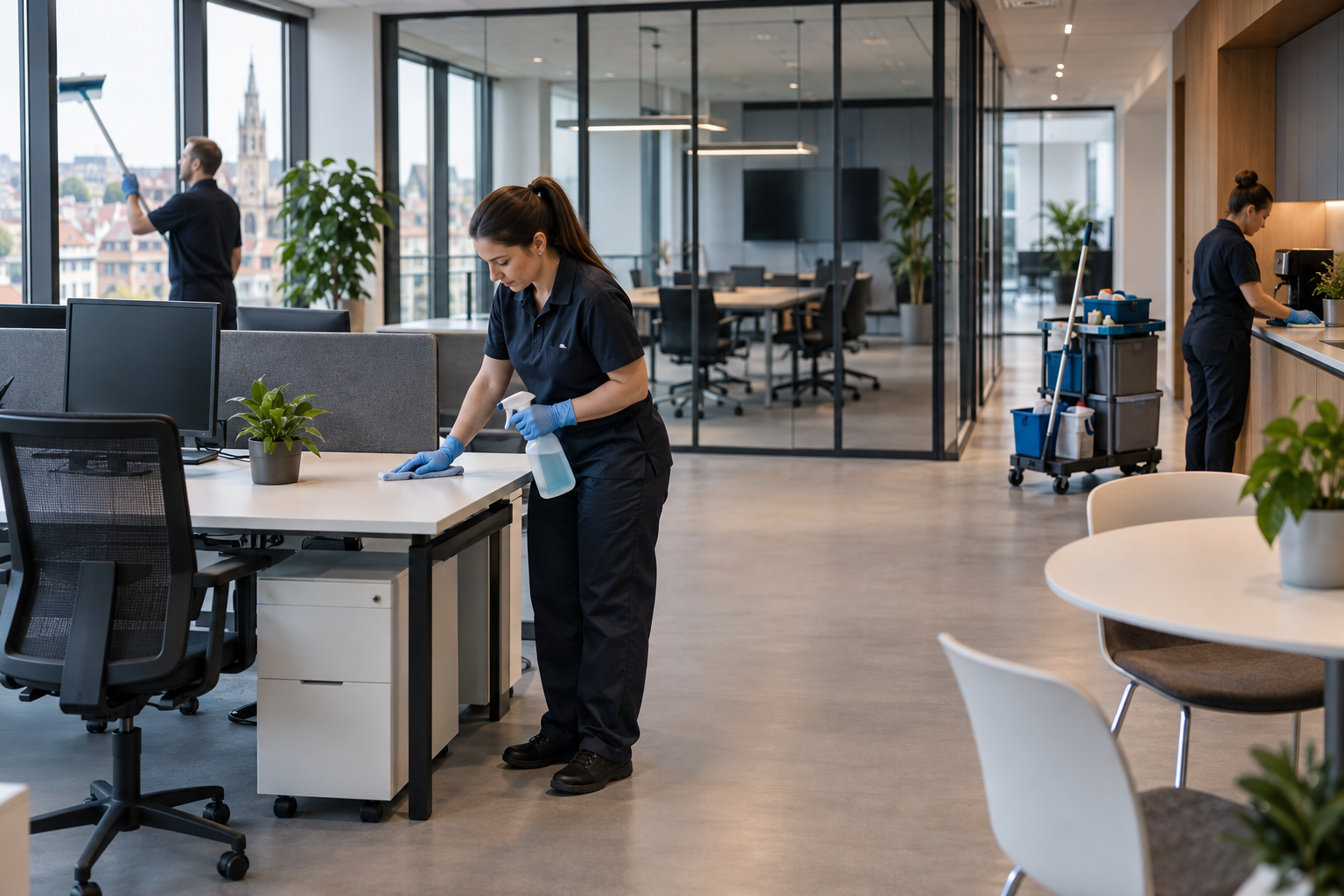
That’s exactly where our approach comes in. The daily maintenance of a retail space involves more than just sweeping the floor and billing by the hour. It’s a service that requires careful management: analyzing foot traffic, determining staffing levels, scheduling cleaning shifts, and ensuring quality control. KHOMCLEAN takes full responsibility for these operational tasks so you can stay focused on what you sell.
In-House Cleaning vs. Outsourcing: Selection Criteria
Let’s start with the calculation that few managers see through to the end. An in-house janitor working 35 hours a week at the standard minimum wage for the cleaning industry costs you about €2,300 to €2,500 per month, all expenses included. Add in the equipment: a decent self-propelled scrubber-dryer costs between €4,000 and €9,000 to purchase, a single-brush machine €1,200, not to mention monthly consumables, pads, cleaning products, and carts. Then factor in what no one budgets for: paid time off, three weeks of sick leave, hiring a replacement when someone leaves, product training, the DUERP (Single Document on Occupational Risks), safety data sheets, and certification checks if you use a cherry picker for high-rise window cleaning.

The real one sales and marketing expenses Internally, this isn’t just a salary. It’s a salary, plus an investment position, plus a vague administrative burden that lands on your store manager’s desk. One site manager told us he spends about four hours a week on cleaning-related issues. Four hours. Over the course of a year, that adds up to more than four weeks of work spent on scheduling and ordering cleaning supplies.
However, in-house management still makes sense in two scenarios. First scenario: a very small space—less than 100 m²—where routine maintenance takes just thirty minutes a day and can be handled by the sales team during opening or closing procedures. Second scenario: a site with strict confidentiality or security requirements, where the presence of an outside contractor poses a real problem. Aside from that, the’outsourcing of cleaning services comes out on top in almost every category.
What criteria, exactly? I rank them in this order. First, technical expertise: as soon as you have porous tile, polished concrete, hardwood floors, linoleum, or resin flooring, each surface requires a different cleaning protocol and products with the appropriate pH level. An untrained worker will damage a floor within six months, and restoration costs ten times more than proper maintenance. Next, operating hours: a business open from 9 a.m. to 8 p.m., six or seven days a week, requires coverage that no single employee can ever provide. Finally, there’s service continuity. This is the factor that tips the scales for most of our clients: a service provider commits to a result and replaces absent staff, whereas an absent employee leaves a gap.
One final, less obvious factor: variability. Your need for Professional Store Cleaning It’s not the same in July as it is in December, nor is a week of sales the same as a Tuesday in February. An outsourced contract can be adjusted. An employment contract, much less so.
Determining Frequency and Staffing: Our Expert Recommendations
Three questions are all it takes to determine the scope of a service: how many people pass through the site each day, which areas are actually exposed, and when can work be carried out without disrupting operations. The rest follows from there.
The traffic frequency It then depends on the specific areas. In a high-traffic retail location, restrooms require two to three cleanings per day. The floors in the entrance area and checkout lanes require at least one cleaning per day, and two during rainy weather or peak hours. Fitting rooms should be cleaned every day, without exception. Back rooms and storage areas should be cleaned two to three times a week. For the Daily warehouse cleaning, the approach is slightly different: the aisles and platforms account for the bulk of the cleaning needs, with daily mechanical sweeping, while the racks undergo scheduled periodic dusting. On top of that, there’s a periodic maintenance plan: thorough descaling, spray cleaning of protected floors, annual stripping, and monthly or quarterly window cleaning.
The maintenance staffing needs This is determined by this schedule, not by intuition. A concrete example: a 1,400 m² retail space open seven days a week, with two restroom facilities and a dining area. For us, the right staffing level means one employee working two hours in the morning before opening, a one-hour cleaning shift midday, and a team leader who oversees three locations in the same area. Not two full-time employees working at the same time, and not a single employee who’s overwhelmed.
When it comes to the method, the basics remain the same. Three rules govern every cleaning step: move from the cleanest to the dirtiest areas, from top to bottom, and from the back to the exit. These rules prevent recontamination—that is, re-soiling the areas you’ve just cleaned. The complete cycle consists of four steps: pre-cleaning (dusting, picking up debris), applying detergent and allowing sufficient contact time, rinsing, and drying. Disinfection comes only afterward, on a surface that is already clean; otherwise, it serves no purpose.
There are also three types of cleaning procedures, and confusing them is the source of most misunderstandings: routine daily cleaning, periodic deep cleaning, and targeted disinfection of high-touch surfaces. On the point-of-sale hygiene, Four rules are all it takes to maintain a facility: clean hands and clean equipment, strict adherence to a color-coded system for cleaning cloths, precise measurement of cleaning products, and written records of cleaning rounds. It sounds simple on paper. It’s consistency that makes the difference.
Traditional Service Provider vs. KHOMCLEAN Management: What's the Difference?
You’ve probably been through this before. The service provider signs on, the service gets off to a good start, and three months later, the quality drops. The agent has been replaced without your knowledge, the new one isn’t familiar with the site, the restrooms in the back are neglected on weekends, and your sales representative now takes ten days to respond. This isn’t dishonesty—it’s a business model: many companies sell “hours of presence” and leave the staff member to handle the site on their own.
Our approach is based on a different premise. We don't sell hours; we take on a operational management "Complete." What does that actually mean in practice?
-
A site audit prior to cost estimation. Survey of surface areas by type of flooring, traffic counts, identification of critical areas, and time constraints. We walk away with a detailed service plan that includes cost estimates—not just a price per square meter pulled from a spreadsheet.
-
A dedicated site manager. He visits the site, conducts an inspection using a self-assessment checklist, trains staff on specific coatings, and corrects any issues before you even have to point them out.
-
Guaranteed continuity. Absences, time off, departures: we handle the replacement with a team that’s already been trained on-site. This is the most time-consuming part of the maintenance staff management, and that's exactly the one you no longer have to wear.
-
Clear reporting. Tracking of visits, regularly updated log, and reported issues. You know what was done and when.
-
A single point of contact. For services, supplies, one-time glass repair needs, or post-construction repairs.
This service management changes the nature of the relationship. A shopping center manager doesn’t need to know which disc to use on epoxy resin, nor does he need to mediate between two vacation schedules. His job is all about occupancy rates, store revenue, and visitor satisfaction. Ours is to ensure that the issue of cleanliness never comes up in his meetings. A zero cleaning hassle which isn't just a slogan but a matter of organization: we remain in charge of coordination.
Here’s a figure to illustrate this. For a contract we took over in 2023—involving seven locations of the same chain—we reduced the number of monthly complaints from eighteen to two in four months. We didn’t do this by adding more hours—we did it by redistributing shift schedules based on actual foot traffic, training staff on the two types of flooring present, and implementing a weekly review. The overall budget even decreased slightly, because hours were being allocated where they weren’t needed.
We believe that the quality of the’Daily Maintenance of a Business 20% of the outcome depends on the technical skill itself, and 80% on the organization surrounding that skill. Even the best agent in the world, if poorly briefed, lacking the right equipment, and without a backup in case of absence, will produce only average results. An agent who is properly equipped, trained for the site, and supervised will produce consistent results.
Conclusion
Let’s keep three things in mind. The actual cost of in-house maintenance far exceeds the «salary» line item in your budget. The frequency of cleaning visits is calculated based on foot traffic and floor area, not on long-standing habits. And the difference between two service providers isn’t found in their quotes, but in how they handle the unexpected on a Tuesday morning.
If you still find yourself spending time each week figuring out your cleaning needs, that’s a sign that the service isn’t being managed properly. Let’s discuss it: we’ll visit your site, assess your floor space and specific requirements, and provide you with a detailed service plan that includes cost estimates and justified cleaning frequencies for each area. There’s no obligation, and you’ll receive figures you can compare.
Frequently Asked Questions
Is it better to handle store cleaning in-house or outsource it?
In-house cleaning remains a viable option in two cases: a very small area of less than 200 m², where cleaning takes just thirty minutes and can be handled by the sales team; and a site with strict confidentiality or security requirements. Outside of these situations, outsourcing offers advantages in terms of the technical complexity of the flooring, operating hours, and service continuity.
How much does an in-house janitor actually cost?
Expect to spend approximately €2,300 to €2,500 per month, all expenses included, for a full-time (35-hour) employee, plus equipment (€4,000 to €9,000 for a self-propelled scrubber-dryer, €1,200 for a single-brush machine) and supplies. On top of that, there are vacation time, sick leave, recruitment, training, and the administrative burden that falls on your site manager.
How often should the different areas of a retail location be cleaned?
At a high-traffic site, restrooms require two to three cleanings per day when visitor numbers exceed 500 per day. The floors in the entrance and checkout areas require at least one cleaning per day, and two during rainy weather or periods of high traffic. Fitting rooms should be cleaned daily, and storage areas two to three times a week.
What sets KHOMCLEAN apart from a traditional cleaning company?
Many service providers sell on-site hours and leave the agent to manage the site alone, which explains the decline in performance observed after a few months. Here, the approach is one of proactive management: an audit before pricing, a dedicated site manager who oversees and trains staff, coverage for absent staff provided by a pre-trained partner, clear reporting, and a single point of contact.
How does the initial contact and the process of getting a quote work?
The team visits your site, surveys the floor areas by type of flooring, counts foot traffic, and identifies critical areas and time constraints. You’ll then receive a detailed service proposal with justifications for the frequency of service by area—with no obligation—rather than a simple rate per square meter pulled from a spreadsheet.


 Français de Belgique
 English
 Nederlands (België)
0 Comments